Factory Vacuum System Design – Step-by-Step Project Plan
Table of Contents
- Why Is Factory Vacuum System Design a Critical Engineering Process?
- How Is the Factory’s Vacuum Requirement Determined?
- How Are Vacuum System Capacity Calculations Performed?
- Why Is Vacuum Line Piping Design a Critical Step?
- What Benefits Does a Central Vacuum System Bring to the Factory?
- How Is Vacuum System Automation Planned?
- How Is Energy Efficiency Evaluation Conducted in the Project Plan?
- Why Are Risk Analysis and Safety Planning Mandatory in Design?
- How Is the Vacuum Receiver (Tank) Volume Calculated?
- Which Steps Should Be Followed in the Project Plan?
- How to Determine the Most Suitable Vacuum System for Your Factory?
Why Is Factory Vacuum System Design a Critical Engineering Process?
Factory vacuum system design is a critical engineering process that increases efficiency in modern production facilities, ensures process continuity, and reduces energy costs. Proper design of a vacuum system is only possible through correct selection of industrial vacuum system components, meticulous vacuum calculations, and optimisation of the entire line according to the factory’s unique operating conditions. This project plan provides an applicable framework both for central vacuum systems and machine-mounted line-type solutions, covering numerous engineering details from process vacuum requirement analysis to vacuum line piping design, energy efficiency evaluation, and determination of vacuum control panels.
The vacuum system can also be described as the factory’s “invisible backbone. Packaging, drying, forming, pressing, leak testing, material handling, and robotic processes are all directly dependent on a healthy vacuum infrastructure. Even a small vacuum fluctuation in the line can affect product quality, increase scrap rates, and cause machines to shut down. Therefore, the design process should not be seen as purely theoretical calculations; it must be handled together with field experience, observations from maintenance teams, and expectations of the production planning department. This is the only way to establish a balanced, reliable, and sustainable vacuum architecture both at the initial investment stage and throughout long-term operation.
How Is the Factory’s Vacuum Requirement Determined?
The first step of any project is to clearly define in which vacuum level range the factory’s processes operate, how much flow rate is required, and at which stages of production vacuum is mandatory. During on-site surveys, engineers create a detailed database by analysing pressure losses and performance data of existing equipment. A separate vacuum demand profile is created for each machine, including operating time, peak load moments, standby modes, and variable capacity requirements.
Sector dynamics play a decisive role in the analysis phase. In food production, hygiene, cleanability, and oil-free air come to the fore, while in chemical plants resistance to aggressive gases, material chemistry, and sealing class become far more critical. In plastics production, injection machines operate under high load for long and repetitive cycles; therefore, vacuum source stability and thermal management capability gain importance. Separate vacuum profiles must be defined for each process in glass, ceramics, textile, or paper industries, and a “process-based” evaluation should be adopted instead of a one-size-fits-all approach. Thus, the needs-based analysis performed at the very first design step ensures that all subsequent calculations and equipment selections proceed correctly.
How Are Vacuum System Capacity Calculations Performed?
Accurate vacuum pump capacity calculation ensures stable operation of all system components. The flow rate required by the process, target vacuum level, piping lengths, and pressure losses in the line are the fundamental inputs of these calculations. One of the most critical data points in engineering is the pump’s vacuum performance curve, which directly shapes design decisions by showing the flow rate the pump can provide at different pressure levels. Interpreting the curve according to the operating point is mandatory for both energy efficiency and process stability.
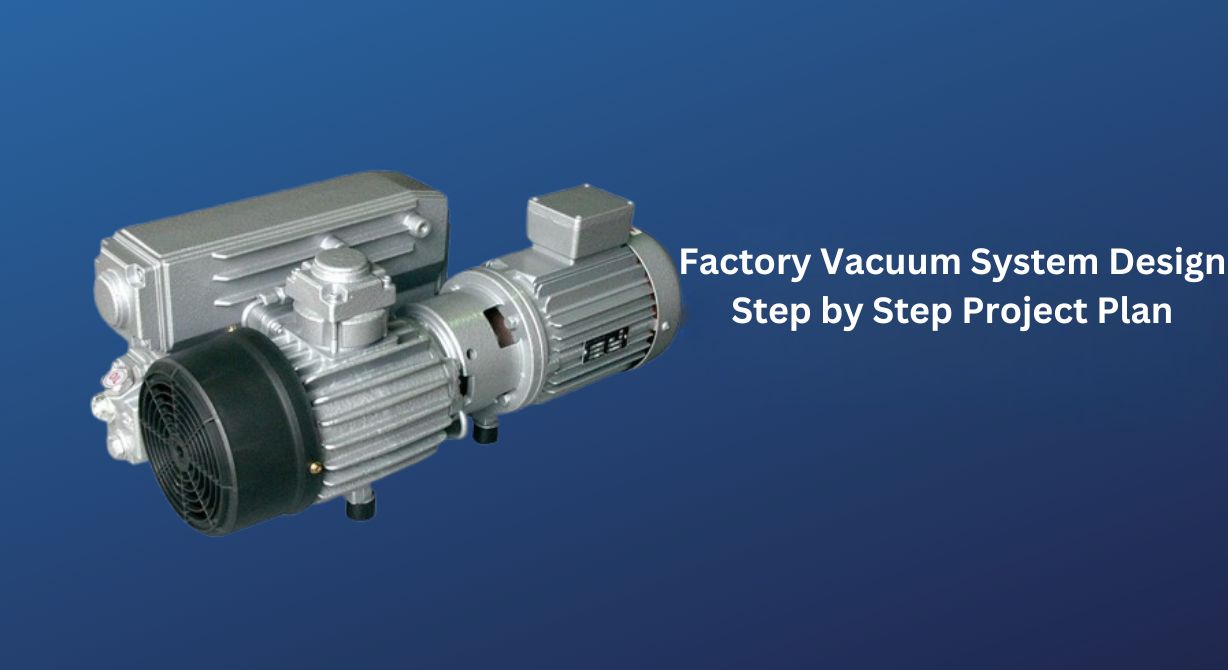
When determining capacity, instead of focusing only on a single machine’s need, simultaneous operation scenarios of all machines on the same line must be considered. Relying solely on average flow, for example, can cause dramatic vacuum drops during peak consumption. In high-vacuum applications or lines requiring multiple pumps, an engineering comparison is made between Roots, dry, and long-life oil-lubricated vacuum systems. Each pump type has different advantages, durability, service intervals, and efficiency maps. Therefore, capacity calculations should not be based only on catalogue data but should be supported by simulation of real field conditions. This approach prevents both oversized systems that waste energy and undersized systems that cause chronic vacuum drops.
Why Is Vacuum Line Piping Design a Critical Step?
One of the most overlooked topics in factories is vacuum line piping design. Yet, incorrect pipe diameter selection, unnecessary line lengths, sharp bends, sudden constrictions, and low-quality connections can create significant pressure losses. These losses impose unnecessary load on the pump, increase energy consumption, degrade the vacuum level reached at the process point, and reduce production stability. Engineers must evaluate many details during the design phase, from pipe inner surface roughness to leak test results at connection points.
When creating the piping plan, theoretical diameter calculation alone is not sufficient. The number of elbows, valve types, filter elements used, condensate drain points, and potential contamination risks must also be taken into account. Packaging lines with high cycle counts require extremely low-loss piping structures for rapid pressure equalisation. In CNC machining centres and robotic solutions, piping configurations that are resistant to sudden vacuum demands, provide volumetric balance, and prevent backflow are essential. A poorly designed pipe network can overshadow even the most advanced vacuum pump’s performance. Therefore, pipe routing, diameter selection, and connection elements must be among the main headings of system design.

What Benefits Does a Central Vacuum System Bring to the Factory?
Many modern facilities prefer the central vacuum system approach. This model both reduces energy consumption and creates a much more sustainable structure compared to installing separate pumps on each machine. The central system provides significant advantages in heat management, noise control, and maintenance organisation. By gathering vacuum pumps in a dedicated machine room, noise level in the production area is reduced, thermal load is removed from the line, and maintenance teams’ access becomes easier.
In central vacuum architecture, the number of pumps, capacity stages, and backup options are determined according to the factory’s production plan. In some cases, a main pump group carrying the base load plus auxiliary groups that activate only during peak demand becomes the ideal solution, preventing unnecessary energy consumption during low-load periods. Central systems also offer advantages in occupational health and safety through standards-compliant monitoring and reporting. Controlling all vacuum parameters from a single centre helps detect potential risks early. From an engineering perspective, a correctly designed central system provides years of operational stability and serves as a strong infrastructure for future modernisation projects.
How Is Vacuum System Automation Planned?
In modern factories, vacuum systems are no longer considered merely mechanical equipment groups. Fully digital systems with smart control panels, pressure sensors, flow meters, temperature probes, and performance monitoring software come to the forefront. Vacuum system automation creates enormous value in energy management and production performance. The automation architecture must be designed with real-time data generation capability, rapid response to alarm scenarios, and predictive maintenance algorithms.
During control strategy planning, the key parameters to be used are clearly defined — for example, whether fixed-pressure control or variable-load logic will be used. Vacuum pumps equipped with variable frequency drives can significantly reduce energy consumption by adjusting speed according to demand. Control panels can be programmed for sequential activation of different pump groups, equal aging (ensuring equal operating hours across pumps), and automatic bypass functions. Integration with SCADA or MES systems makes the vacuum system an integral part of the factory’s overall digital infrastructure, allowing both operators and management to monitor vacuum performance instantly.
How Is Energy Efficiency Evaluation Conducted in the Project Plan?
To understand the total cost of a vacuum system project, focusing only on installation cost is insufficient. Energy efficiency evaluation is one of the most important factors determining long-term operating costs. During the design phase, engineers prepare energy consumption forecasts and compare the power the system will consume in different operating modes, resulting in a clear energy analysis for different pump types and control strategies.
Total cost of ownership (TCO), maintenance cycles, consumables need, pump durability, efficiency curves, and future modernisation options are evaluated together. Smart vacuum solutions with variable-speed drives can provide significant savings during low-load periods. Conducting pilot tests using energy analysis software and measurement devices facilitates projections based on real field data. In an environment where energy costs rise every year, vacuum systems not designed with efficiency in mind quickly become a budgetary problem. Therefore, energy analysis should not be a side appendix but one of the central chapters of the project documentation.
Why Are Risk Analysis and Safety Planning Mandatory in Design?
Since the vacuum system is one of the core infrastructure components at the heart of the factory, the design process must include a detailed risk analysis and safety plan. Potential oil contamination scenarios, vacuum level instability, pump overheating issues, pipe collapse risks, and effects of sudden pressure changes are evaluated during the project. Risk analysis must be performed not only from an equipment perspective but also regarding personnel safety, product quality, and environmental impact.
The safety plan includes emergency stop procedures, pressure relief valve capacities, backflow prevention equipment, fire scenarios, and gas evacuation systems. In sensitive sectors such as chemicals, pharmaceuticals, or food, a vacuum system failure can directly lead to product safety issues. Therefore, compliance with standards and regulations is an inseparable part of the design. Preventive measures are defined for critical points identified in the risk analysis — design revisions, additional sensors, or different material choices raise the safety level. Thus, the vacuum infrastructure becomes not only efficient but also safe and auditable.
How Is the Vacuum Receiver (Tank) Volume Calculated?
On production lines experiencing sudden demand fluctuations, correct vacuum receiver volume calculation is one of the factors directly affecting system stability. Proper tank sizing balances process load, reduces vacuum level fluctuations, lowers pump on/off frequency, and significantly extends equipment life. Calculation considers process cycle times, pressure drop tendencies, demand patterns, and the capacity of the pump to be used.
If the receiver volume is insufficient, vacuum drops rapidly during peak demands and process equipment cannot deliver required performance. If the volume is excessively large, the system becomes sluggish and initial startup time increases. The engineering calculation requires both theoretical formulas and field experience. Receiver design becomes especially critical in packaging lines, pick & place robots, and high-speed packaging machines. Pressure sensor placement, inner surface quality, and condensate drainage arrangement are also evaluated together with the volume calculation.
Which Steps Should Be Followed in the Project Plan?
The sequence of steps in a factory vacuum system project plan is crucial for maintaining engineering discipline. The first phase involves process analysis and clarification of vacuum requirements: which lines need which vacuum level, how flow demand changes over time, shift structure, and growth projections. This is followed by capacity calculations, piping design, and pump selection.
The next phase includes automation requirements, energy analysis, and risk assessment. Control panel structure, sensor placement, alarm scenarios, energy-saving control algorithms, and remote monitoring options are planned at this stage. Maintenance strategy, warranty and service organisation, spare parts supply time, and documentation requirements are also included in the project plan. Separate timelines are prepared for design, installation, commissioning, testing, and performance verification phases, creating a sustainable roadmap both technically and managerially.
How to Determine the Most Suitable Vacuum System for Your Factory?
In the final stage, engineers evaluate vacuum solutions suitable for the project using a system comparison method. Energy consumption, process stability, equipment durability, environmentally friendly vacuum technologies, maintenance ease, and alignment of automation level with the factory vision come to the forefront. Modernisation goals, process improvement plans, and operating budget are inseparable parts of the decision process.
Different pump types, central vs. local placement options, control strategies, and future capacity increase scenarios are all put on the table during comparison. Advanced technology vacuum solutions offered by Gücüm Pompa have been developed with an engineering-focused approach that meets expectations in factory modernisation, automation integration, durability, and energy savings. When evaluated together with on-site survey, performance measurement, TCO analysis, and post-project technical support, the vacuum system decision ceases to be merely equipment procurement and becomes a strategic investment that increases the factory’s competitiveness.