Oil-Sealed and Monoblock Vacuum Pumps: A Comparison by Application
Table of Contents
- Why Selection Should Start from the Application
- Monoblock Design: Compact and Low Maintenance
- Oil-Sealed Paletted Type: Deep Vacuum Without Water
- Vacuum Level: Which Value Suits Which Plant?
- Space, Maintenance and Investment Balance
- Questions for a Decision Table
The most common mistake when selecting a vacuum pump is reading only the catalogue of the device. Two pumps of the same capacity can give very different results in different applications because of their designs. This article explains how to compare oil-sealed paletted and monoblock vacuum pumps according to the needs of the application.
Why Selection Should Start from the Application
Correct pump selection begins with defining what the process needs. The target vacuum level, the required flow, the amount of vapour or moisture in the process, the operating hours and the maintenance capacity are the main factors in selection. Without this information, one type cannot be judged as "better" than another.
The comparison below describes general tendencies. For a final selection, the manufacturer's performance curves and process data should be the basis.
Before choosing between a vane type and a monoblock vacuum pump, the application the pump will serve should be clarified. Two pumps with the same technical figures can give completely different results in a food plant and in a chemical plant. The vacuum level, volume, temperature and cleanliness requirements of the application are the first determinants of the pump type.
Choosing a pump type relates not only to the purchase price but also to the life cycle cost. Energy consumption, maintenance frequency, availability of spare parts and the life of the pump form a total cost that is far greater than the initial investment. For this reason the comparison should be made from a perspective of five or ten years.
When the application is analysed, it should also be assessed how vapour and liquid formed in the process will reach the pump. In some applications the material entering the pump can mix with oil and spoil product quality. In such a case an oil free solution may be more suitable, and the selection should start from this point.
A monoblock design is a solution in which the motor and the pump housing are combined in a single structure. This combination makes installation easier, reduces the number of pipe connections and gives a compact layout. For plants working in a small area this feature is very valuable.
Monoblock Design: Compact and Low Maintenance
Monoblock pumps are compact designs in which the motor and pump casing are combined into a single unit. With no coupling connection, alignment work is reduced and the installation footprint is smaller. The use of stainless steel stage plates and a mechanical seal helps limit maintenance requirements.
This design is advantageous in plants where space is limited and on lines that run continuously and can be maintained regularly. The fact that noise can be managed thanks to the compact structure is also one of the reasons for preferring it.
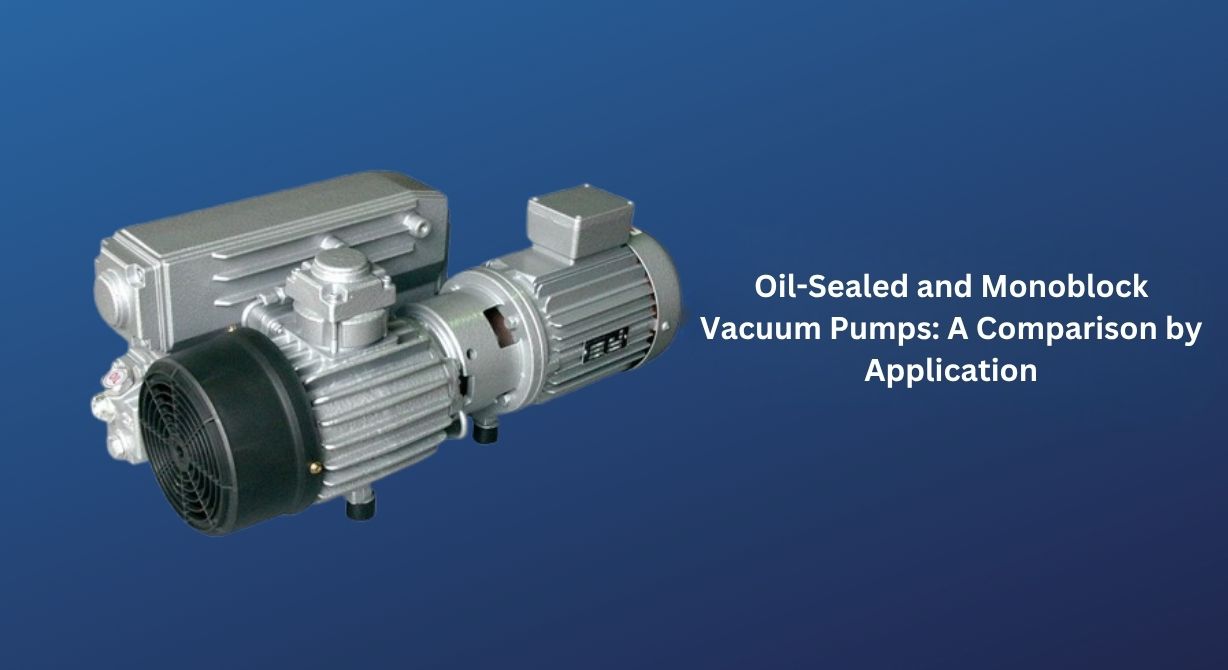
The maintenance need of a monoblock pump is usually lower, because it does not require a separate coupling and alignment. The bearings and mechanical parts work with the motor inside a single closed structure. This largely removes the failures caused by alignment errors.
A limitation of the monoblock design is that the whole unit may have to be replaced in case of failure. Because the motor and the pump are not separated, the service team may need to open the entire unit even when only one part is damaged. Keeping a spare unit in stock is a practical way to reduce this risk.
When a monoblock pump is selected, it should also be assessed how the motor temperature affects the fluid inside the pump. In a closed housing the heat of the motor can be transferred to the pumped fluid. This effect should be considered in applications sensitive to temperature.
Oil lubricated vane type pumps have a structure in which the rotating vanes slide over an oil film and which can reach high vacuum levels. For applications that need deep vacuum this type is usually the first choice. The oil both seals and cools, and it determines the efficiency of the pump.

Oil-Sealed Paletted Type: Deep Vacuum Without Water
Paletted-type pumps are mounted on an oil tank and operate with oil. This design is preferred because it can reach very low pressures and can run without water. The advantage is clear in plants where water use is not possible or where water supply is difficult.
The price of the oil-sealed structure is the need for regular oil checks and changes. Oil level, colour and condition sit at the centre of the maintenance plan. In applications where process vapour or contaminated gases are present, the oil change interval may need to be shorter.
The most important advantage of the oil lubricated vane type is that it can work without water. This feature is a great convenience in plants where service water is hard to obtain or where water consumption is expensive. Because it does not need a system in contact with water, problems of moisture and freezing around the pump are also reduced.
The disadvantage of the oil lubricated vane type is that it requires oil management. Periodic oil change, leak control and measures to prevent the oil from mixing with the process product increase operating costs. The disposal of used oil as waste is also an environmental obligation.
In oil lubricated vane pumps the quality of the oil is a direct indicator of vacuum performance. When the oil becomes dirty or degraded, the vacuum level falls over time and the pump runs hotter. For this reason oil analysis should be an important part of the maintenance programme.
The vacuum level is one of the most decisive criteria in pump selection. Every application needs a different vacuum value, and the lowest pressure the pump type can achieve should be compared with this need. Choosing a wrong vacuum level leads either to a pump that is not enough or to one that is unnecessarily expensive.
Vacuum Level: Which Value Suits Which Plant?
The vacuum level is one of the most decisive criteria in selection. The maximum vacuum value of monoblock designs is limited to higher pressures than oil-sealed paletted types. Paletted types, on the other hand, offer an advantage in applications requiring very deep vacuum.
The target vacuum value should be set according to both the needs of the system and the losses in the line. Line length and leaks can increase the value the pump must reach, so line losses must always be taken into account in the selection.
In low and medium vacuum applications monoblock types are often sufficient and offer an economical solution. In these applications an excessive vacuum capability may mean an unnecessary investment. However, since the vacuum level needed is low, it is important to select the range in which the pump works efficiently.
In plants that need deep vacuum, oil lubricated vane types may be more suitable. Their ability to reach high vacuum levels is the strongest side of this type. However, a pump designed for deep vacuum can also be inefficient when run at lower vacuums, so this matching should be done carefully.
Vacuum level and volumetric capacity should be considered separately. A pump reaching a high vacuum does not mean that it also provides a high flow. If the process needs both vacuum and quick evacuation, both properties should be evaluated separately.
Space restriction is a frequent limit in pump selection. The monoblock design gives an advantage in small areas, whereas an oil lubricated vane type may need a wider layout and additional equipment. Space should be reserved for the oil tank, the oil filter and, if necessary, an oil cooler.
Space, Maintenance and Investment Balance
The monoblock design is generally more advantageous in terms of installation space and initial assembly time. The oil-sealed paletted type can take up more room because of the oil tank and additional equipment, but its features, such as deep vacuum and not needing water, demonstrate its value in specific applications.
Make the investment decision based not only on the purchase price but on the total life-cycle cost. Energy consumption, maintenance frequency, oil and water costs and shutdown times should be considered together.
The maintenance area is also part of the selection. An oil lubricated vane type needs an accessible area so that the oil level and oil change can be done easily. A monoblock pump needs less space for maintenance, but enough clearance must be left to remove the single large part.
The investment budget is also an important column of the decision table. The initial cost of a monoblock pump is usually lower, but in the long run factors such as a spare unit can change the cost. The initial cost of an oil lubricated vane type may be higher, but savings on water and maintenance can close that gap.
Energy efficiency should also be considered in the comparison. Even when two pumps have the same nominal power, their efficiency at the real operating point can differ. Curves showing efficiency in the vacuum and flow range where the pump will work most should be compared.
When preparing the decision table, it can be useful to use a scoring system for each option. Criteria such as vacuum level, energy consumption, maintenance load, space, water need and initial cost can be weighted to give an overall value. This method prevents personal preferences from overshadowing the decision.
Questions for a Decision Table
To clarify the selection, answer these questions: How deep is the target vacuum level? Is water use possible at the plant? How limited is the installation space? Will the maintenance team be able to track the oil of an oil-sealed pump regularly? Is there vapour, moisture or contamination in the process gas?
The answers to these questions largely show which type fits your application. If you are unsure, sharing your process data and goals with an engineer and evaluating them together prevents a wrong investment.
One question in the decision table is how reliable the water supply is. In regions where water cuts are frequent, a system dependent on water creates a big risk. For such plants a water independent oil lubricated vane type may therefore be a safer option.
Another question is how experienced the maintenance team is with oil based systems. In a team without knowledge of oil management, the oil lubricated vane type can lead to frequent errors. Training and the supply of spare parts should be included in this table.
Finally, the decision table should also cover process changes. A pump chosen today for one application may face a different vacuum or volume need tomorrow. A choice that gives flexibility for possible future changes is the decision that causes the least regret in the long run.