Vacuum Pump Annual Maintenance Calendar: What to Do Each Month
Table of Contents
- Why an Annual Plan Is Needed
- First Three Months: Observation and Adjustment
- Middle of the Year: Filter, Oil and Seal Checks
- Additional Steps for Summer and Winter
- Year End: Comprehensive Inspection
- Making the Calendar Work in Practice
Maintenance should not be something done only when a fault occurs. Keeping a vacuum pump performing well requires short checks repeated throughout the year. But when it is unclear which task belongs to which month, maintenance is often postponed. This article explains how to build an annual maintenance calendar by dividing the year into months.
Why an Annual Plan Is Needed
A pump's maintenance needs depend on its operating hours, process temperature, dust levels in the environment and the quality of the service liquid. An annual calendar brings these variables together in one plan and makes responsibility clear. The maintenance team knows what is due when, and production planning can schedule shutdown windows in advance.
The foundation of the calendar is the maintenance interval recommended by the pump manufacturer. These intervals may be shortened for field conditions, but should not be extended beyond the limits the manufacturer has set.
An annual maintenance calendar is a plan that shows which operations are to be done on a pump during the year, at which intervals and in what order. Without such a plan, maintenance turns into unplanned intervention when a fault appears. With the plan, each operation is done on time, resources are set aside in advance and the life of the pump becomes predictable.
The calendar is not only a timetable but a decision tool. It answers questions such as how long each operation takes, when a part must be ordered and in which period production can be stopped. For this reason the calendar should be prepared jointly by the maintenance team and the production planner.
The need for an annual plan comes from the behaviour of the pump itself. A pump meets different conditions in different periods of the year. High temperature in summer, low temperature in winter and changing humidity affect the lubrication, cooling and sealing needs of the pump. Maintenance planned against these variables is much more effective than a single uniform approach.
The annual plan also gives a basis for budgeting. If at the start of the year it is known which maintenance items will occur, which spare parts will be needed and how many labour hours will be spent, the annual budget can be prepared realistically. Emergency purchases made after an unplanned failure, on the other hand, push the budget over its limit.
The first three months of the calendar are a period of observation and adjustment for a new pump or a pump starting a new year. In this period the first operating values of the pump are compared with later values. Indicators such as temperature, vacuum level and motor current are recorded for several weeks and a normal range is set.
First Three Months: Observation and Adjustment
At the start of the year, compare the pump's operating data with the previous year's records. Vacuum level, motor current and temperature trends show the health of the pump at the beginning of the year. At this stage, also check the condition of sealing elements, connection bolts and basic connections.
Continue daily observations in January, February and March, and apply a short weekly checklist. Note changes in sound, vibration and casing temperature.
The adjustments made in the first three months largely determine how the pump will work through the year. Service water flow, vacuum values and relay settings should be reviewed in this period. The data obtained during observation form a reference for later maintenance decisions.
In these three months a first check of the condition of the oil and filter should also be made. How the new oil behaves in the first weeks and how quickly the filter blocks should be observed. This information ensures that the oil and filter change intervals are set correctly for the whole year.
The first three months are also a period in which the team working on site gets to know the pump. When operators learn the normal sound, vibration and smell of the pump, later unusual conditions are easier to notice. Training and observation should go on together in this period.
The middle period is the part of the year where the filter, oil and seal checks are concentrated. In this period the pump has been running for longer than in the first three months, and traces of wear begin to show more clearly. The checks should therefore be carried out in more detail.
Filter checks in the middle period should consider both cleaning and replacement. The degree of blocking, the condition of the material and the seating of the gasket should be checked. If the life of the filter is used up, its replacement with a spare filter should be planned.

Middle of the Year: Filter, Oil and Seal Checks
In the middle of the year, inlet filters, oil level and oil condition should be inspected regularly. A clogged filter directly affects the pump's ability to reach its vacuum value. On oil-sealed pumps, the oil change should be scheduled at the interval given in the catalogue.
On liquid ring pumps, the service water line, filters and discharge line can be cleaned during this period. If scaling is suspected, comparing measurements before and after cleaning is the best way to see the effect of the work.
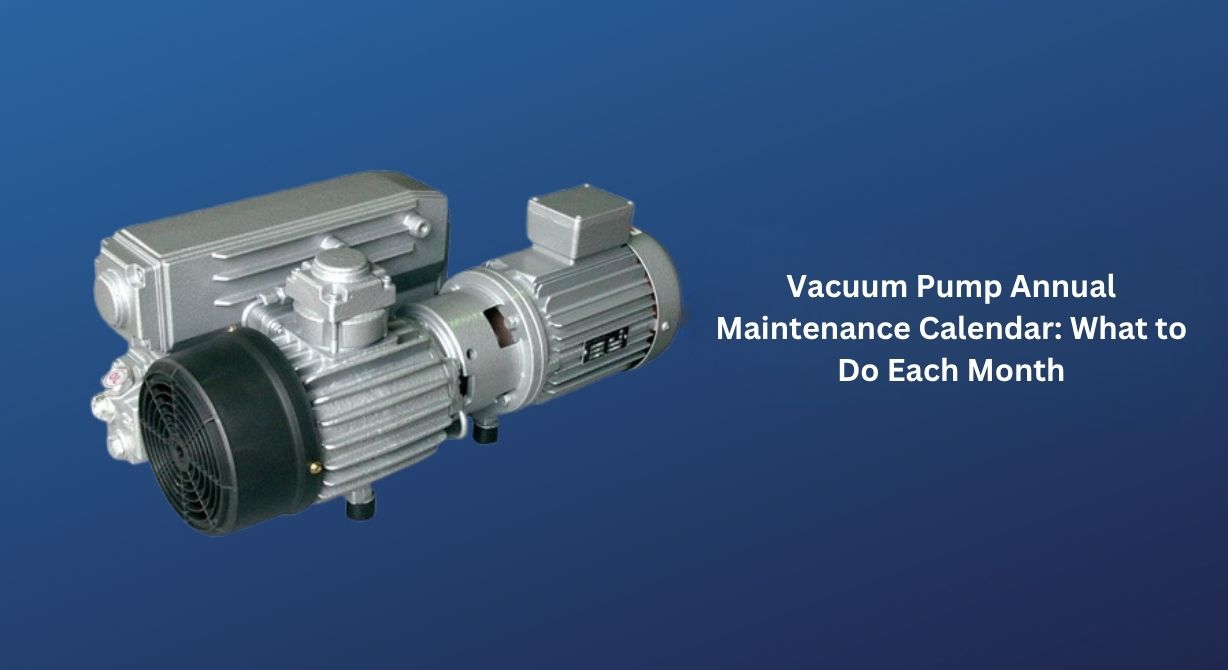
Oil checking is one of the most important steps of the middle period. The colour, level and possible contamination of the oil should be examined, and if necessary a sample should be taken for analysis. Depending on the condition of the oil, the change date can be re-arranged in the calendar.
Seal checks in the middle period should be made on the mechanical shaft seals, flange connections and valve bodies. Early detection of a small leak prevents a large loss of oil or vacuum. Every connection point should be checked by eye and by hand and tightened when necessary.
Summer and winter are two special periods that need additional steps in the calendar. High ambient temperature in summer adds extra load to the cooling system and to the quality of the oil. For this reason it is important to check the cooling system and the service water line before summer.
In the checks before summer, the cooling water flow, the cleanliness of the fans and filters and the oil level should be the priorities. Running the pump in summer without measures against the expected rise in temperature increases the risk of overheating. This preparation helps the summer to pass without trouble.
For the winter period the risk of freezing is the most important issue. The service water lines need to be drained, and insulation and heating measures must be reviewed. A frozen line can seriously damage the pump and the repair can take a long time.
Additional Steps for Summer and Winter
In summer, when ambient temperature rises, cooling and service water temperature become more important. Monitor service water and motor temperature more often during this period. In winter, check the drain and water lines against the risk of freezing; the water in the lines may need to be fully drained.
Reviewing the plan for both seasons one month before each season starts helps prevent unexpected failures.
Before winter, the protective structures of pumps working outdoors should also be checked. Snow load, wind effect and moisture can weaken the protective structure. For this reason the pre-winter checks should be more comprehensive for outdoor pumps.
The year end is the period of the comprehensive inspection of the annual plan. In this period all the parts of the pump are assessed in the light of the year's records. Questions such as how often each fault was repeated, how long each part lasted and which maintenance operation was sufficient are answered.
A comprehensive inspection may require the pump to be dismantled, or at least the covers to be opened to see the internal parts. The wear of the rotor, vanes and blades, the clearance of the bearings and the shaft sealing are the main headings of this inspection. The result of the inspection shapes the plan for the following year.
During the year-end inspection the motor winding resistance and insulation condition should also be measured. Changes that may have occurred through the year under the effect of moisture, temperature and vibration come to light with this measurement. Comparing the measured values with the previous year shows the trends.
At the end of the inspection, all the shortcomings found during the year and the improvements recommended for next year should be written in a report. The report should be shared with management and provide input for the budget and spare parts planning. The recommendations in the report should be added to the calendar for the following year.
Year End: Comprehensive Inspection
At the end of the year, a comprehensive inspection can be carried out that also examines the inside of the pump. This inspection should be performed by an authorised service provider or a trained maintenance team. Bearing condition, coupling alignment, motor insulation and internal surfaces are assessed during this work.
The findings should be used to shape next year's plan. Which part needs replacing soon and which intervals can be extended become clear from this data.
Making the calendar workable covers the steps needed so that the plan does not stay on paper. The person responsible for each operation should be set, the date it will be done should be clarified and it should be recorded when it is completed. A maintenance item with no clear responsibility is usually left undone.
The durations of the operations in the calendar should also be estimated realistically. How long each operation takes should be measured during the first applications and entered in the calendar. In this way the plan for the next year is prepared more accurately on the basis of past experience.
The calendar should be coordinated with the production plan. So that maintenance operations do not coincide with the busy periods of production, the time windows in which the pump can be stopped should be set in advance. This coordination lets both the maintenance and the production go on without interruption.
Another way of making the calendar workable is to set up reminder systems. A digital maintenance software or a simple calendar alert makes sure every operation is reminded on time. Reminders should reach the responsible people at the right moment.
The annual plan should be reviewed at the end of every year. It should be assessed which operations are needed, which have become unnecessary and which durations have changed. This assessment adapts the calendar to the real needs of the plant and turns it over time into a more valuable tool.
Making the Calendar Work in Practice
A good calendar names the person responsible for each month and the materials needed. The calendar can be kept in maintenance software or in a simple spreadsheet; what matters is that everyone can see the current version. Each completed task should be marked as done in the calendar and notes should be added.
Review the calendar together with the production plan. Carrying out work when shutdown windows are suitable costs less than postponing it to the busiest period of production.
In conclusion, the annual maintenance calendar is a planning tool that extends the life of the pump and protects production. The list of what to do month by month is not only a reminder but a plan of responsibility and resources. Regular application of this plan keeps the pump working reliably for many years.