Start-of-Shift Vacuum Pump Check: The Operator's Daily Routine

Table of Contents
- Why the Start-of-Shift Check Matters
- Visual Check: External Surface and Connections
- Sound and Vibration Check
- Reading and Recording the Values
- What to Do in an Abnormal Situation
- Shift Handover and Information Transfer
A short check at the start of each shift catches small problems at the beginning, before they grow during the day. The check does not have to take long; a regular routine of a few minutes allows the pump to run safely throughout the day. This article describes a simple check sequence that an operator can follow at the start of a shift.
Why the Start-of-Shift Check Matters
A pump often starts the day with a problem left over from the previous shift. A leak that developed overnight, a falling oil level or a rising temperature, if not noticed at the first check in the morning, can turn into a fault that stops production during the day.
The real value of the check is knowing the pump's "normal" state and spotting any departure from it quickly. For this reason the check should be carried out every day, in the same order and at the same points.
The start-of-shift check is one of the simplest yet most effective practices that secure the day's running of a pump. If an operator starts work without knowing the pump's state from the day before, it is hard to notice a problem even when one exists. A short check reveals the changes that built up overnight and lets the day's work begin on safe ground.
Another value of the start-of-shift check is the relationship the operator builds with the pump. A person who looks after the same pump every day comes to know its normal state and notices even the smallest deviation from it. This sensitivity helps catch subtle changes that an instrument may not measure.
The timing of the check also matters. At the start of a shift the pump may have been restarted after a long stop or may have run continuously through the night. In either case recording the starting values allows the change during the day to be interpreted correctly.
The visual check is the first step of the start-of-shift check and should begin with the external surface. It should be looked at for any new crack, break, paint flaking or water mark on the pump housing. Every visible change should be recorded as a note.
Visual Check: External Surface and Connections
The first step is to examine the outside of the pump. Look for oil traces, moisture, dust build-up or damage on the body. Check the connection points, particularly on the suction and discharge lines, for any sign of leakage.
On oil-sealed pumps, read the oil level through the sight glass. The level should sit between the marks, and the colour of the oil should not look noticeably different from the day before.
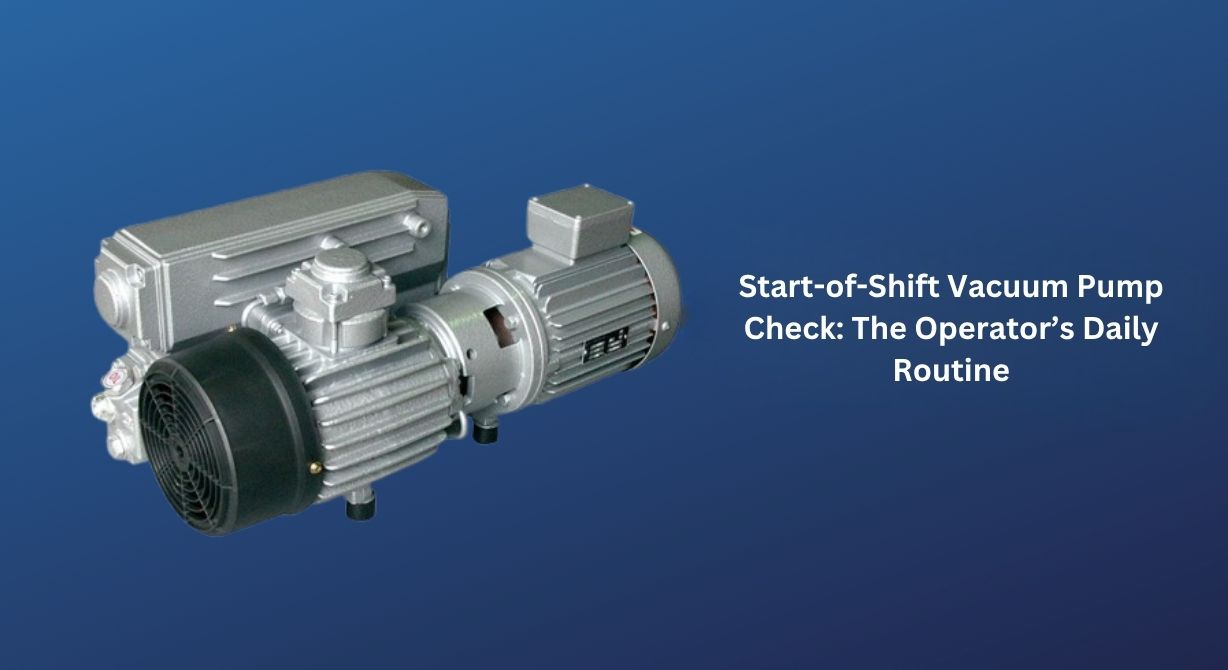
The connection points are also an important part of the visual check. Flanges, valves, cable entries and pipe connections should be looked at for oil marks, leaks or a loosened bolt. Even a small drop of oil can be the start of a leak.
Dust and dirt building up on the external surface is also a point that needs attention. Heavy dust covers the cooling surfaces of the pump and reduces heat transfer. A short cleaning at the start of the shift prevents the effect of this build up on temperature.
The check of the electrical box should include confirming that its cover is closed and sound. A loose or damaged cover can let water and dust in. The sealing glands at the cable entries should also be checked together.
Sound and vibration checks are a sensory assessment that gives the most valuable information about the internal condition of the pump. A normal pump has a particular sound and a particular level of vibration. Knowing this normal level allows the operator to notice a deviation quickly.

Sound and Vibration Check
While the pump is running, listen to it. A steady hum is considered normal; metallic rubbing, knocking or an unusual rattle needs attention. Check the vibration by carefully placing your hand near the pump casing or with a simple measuring device if one is available.
If the vibration has clearly increased from the previous level, note it. An increase in vibration can be the first sign of a problem with a bearing or with the base connection.
In the sound check, a steady hum is accepted as normal, whereas knocking, squealing, metallic rubbing or an intermittent tick are signs that need attention. The direction and place of the sound also give clues. A sound from the motor and a sound from the pump housing can point to different causes.
Vibration can be assessed by touch or with a vibration meter. The normal vibration level of the pump, when it is felt at the same point every day, becomes a reference over time. A clear increase from this reference may signal a bearing or alignment problem.
Reading and recording the values is the most concrete output of the start-of-shift check. Values such as the vacuum level, motor current, oil level, temperature and service water flow should be recorded in a fixed form. These records reveal the trends that build up over time.
The recording of values should be done under the same conditions as far as possible. Values read at a set time after the pump has started should be taken in the same time window each time. This consistency makes the records comparable with each other.
Reading and Recording the Values
At the start of the shift, read the vacuum value, motor current, service water temperature and, where available, the service water flow. Write these values on a pre-prepared record sheet. Next to each value, mark whether it lies outside the normal range.
Records should be kept every day, not only when a problem occurs. Regular recording lets you see weekly and monthly changes and gives the maintenance team concrete data.
During the reading of values it should be made sure that the gauge or sensor is working correctly. A stuck gauge or an un-zeroed sensor can give misleading values. Before reading, it should be checked that the gauge is lit and legible.
When an unusual condition is met, the first thing to do is to judge whether the pump is safe. If there is a leak, a smell of burning, excessive temperature or an unusual sound, the pump should be stopped and the safety procedure applied. Rushing to inspect a pump while it is still running can be dangerous.
In an unusual situation the responsible technician and the shift supervisor must be informed at once. The report should state clearly what was seen, when it was seen and which values were read. A clear report makes it possible to diagnose the problem quickly.
When an unusual condition is observed, the operator should not mix up what was observed with their own guess about the cause. What was seen and what it might be should be written separately. This distinction lets the specialist work with the right information.
What to Do in an Abnormal Situation
If you see a deviation during the check, first carry out the steps within your own responsibility: a simple checklist, whether the line is open, the condition of the filter and whether service water is flowing. If the problem is not resolved by these steps, inform the shift supervisor and the maintenance team without forcing the pump.
If there is smoke, a burning smell, excessive vibration or abnormal temperature at the pump, stop the pump and do not intervene on your own. Follow the safety procedure and inform the team.
Thresholds at which the pump must not be allowed to run should be set in advance for unusual conditions. If a certain temperature or vibration is exceeded, stopping the pump at once makes the operator's decision easier. These thresholds should be available on site as written instructions.
The shift handover is the most critical moment for passing on information. The incoming shift should not start work without learning the state of the pump and the points that need attention. This transition can create a gap in which problems sometimes disappear.
Leaving a written note at the handover prevents information loss. The note should contain the last state of the pump, the values that have changed, the interventions made and the work still pending. The note should be short, clear and in order.
A verbal handover should also take place at the changeover. Using a written note and a verbal handover together ensures that information is not lost and lets the incoming shift clarify the matter by asking questions.
Shift Handover and Information Transfer
At shift change, verbally passing on the pump's condition is not enough. The previous shift's records, open tasks and values to be monitored should be handed over in writing. The incoming shift should read this information and carry out its own check accordingly.
A regular check and a short handover note allow the team to get consistent results even when different people run the same pump. This routine clarifies the operator's responsibility and at the same time preserves the knowledge held on site.
After the shift handover it is useful for the incoming operator to carry out their own first check and confirm that the handover note is accurate. This works as a second pair of eyes and increases the reliability of the records.
In conclusion, the start-of-shift check is the foundation of the pump running safely and efficiently through the day. When visual, sound and numerical checks are done together, problems are noticed before they grow. The shift handover makes sure this knowledge is passed between teams without a break.