


In a facility with multiple machines or process points needing vacuum, there are two fundamental approaches to system architecture: building a single central vacuum system, or assigning each machine its own independent pump. This decision affects not only equipment cost, but also energy efficiency, maintenance workload, and the facility's operational flexibility. This article compares the advantages and disadvantages of both approaches and covers which situations favor each one.
Table Of Contents
- What Is a Central Vacuum System, and How Does It Work?
- What Is the Point-of-Use Pump Approach?
- What Efficiency Advantages Does a Central System Offer?
- What Are the Disadvantages of a Central System?
- What Advantages Does the Point-of-Use Approach Offer?
- What Are the Disadvantages of the Point-of-Use Approach?
- Which Approach Fits Which Situation?
- Frequently Asked Questions
What Is a Central Vacuum System, and How Does It Work?
In a central vacuum system, typically one or a few high-capacity pumps supply vacuum to multiple machines or process points across a facility through a piping network (a vacuum manifold). Each point connects to this shared line according to its own need.
This approach is particularly common in facilities with many similar vacuum needs — for example, production lines with rows of similar machines — because a single system offers a centralized solution instead of scattered individual pump investments.
What Is the Point-of-Use Pump Approach?
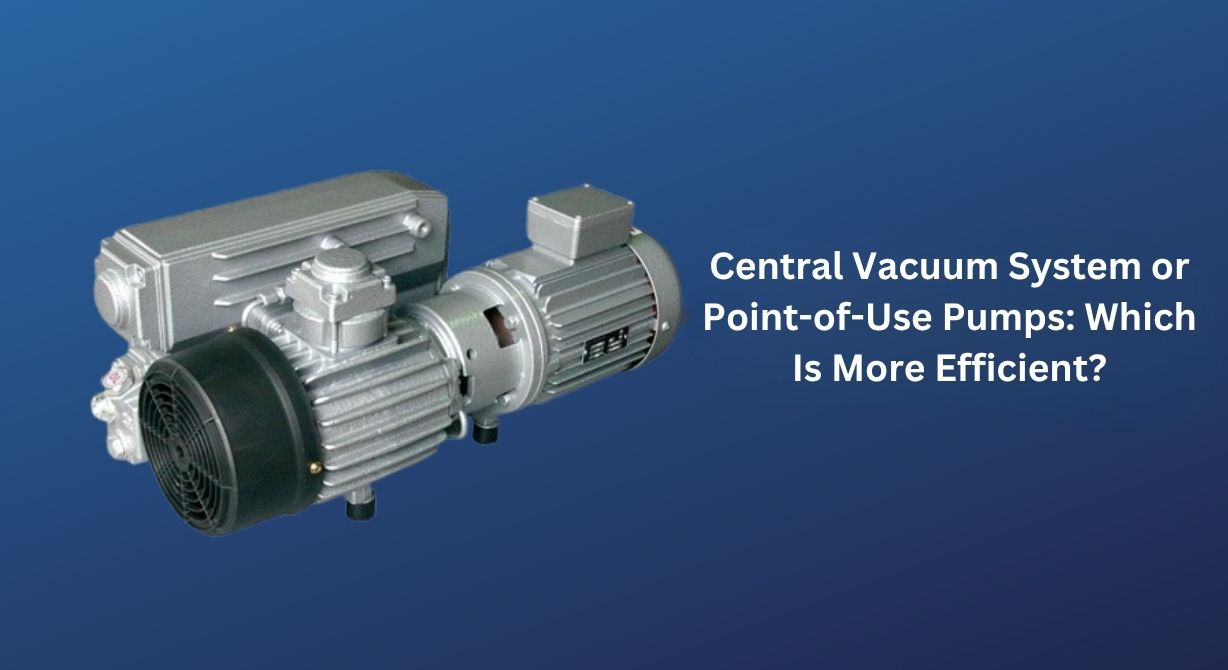
In the point-of-use approach, each machine or process point has its own independent vacuum pump, typically positioned right next to or on the machine itself. There's no shared piping network in this approach; each system operates on its own.
Compact, lower-capacity pumps like Gücüm Pompa's monoblock series suit this kind of point-based application particularly well; as covered in our article "When Is a Monoblock Liquid Ring Vacuum Pump Better Than a Coupled Design?", this series has a compact, easily installed structure.
What Efficiency Advantages Does a Central System Offer?
One of a central system's biggest advantages is economy of scale: a single high-capacity pump can often operate more efficiently per unit of capacity than the sum of many small pumps. It's also rare for every point in a facility to demand peak vacuum simultaneously; thanks to this "diversity" effect, a central system's total installed capacity can be sized smaller than the sum of every point's individual peak demand.
Maintenance is another area where central systems have an edge: regular maintenance on a small number of large pieces of equipment is generally easier than individually tracking many scattered small pumps. Automation and energy management — demand-based speed control, for instance — are also easier to implement on a central system.
What Are the Disadvantages of a Central System?
A central system's biggest risk is a single point of failure: a failure in the main pump or central line can affect every connected point simultaneously, unless redundancy measures are built in.
Long piping runs also introduce pressure loss between the pump and distant points; this loss can require the pump to generate a deeper vacuum than what's actually needed at the point of use, meaning some efficiency loss. If different process points work with different gas or vapor types, combining them on a shared line can also create a cross-contamination risk similar to the one covered in our article "What Separates Water-Circulated and Oil-Circulated Vacuum Units?"
What Advantages Does the Point-of-Use Approach Offer?
The point-of-use approach's biggest advantage is independence: when a pump on one machine fails, only that machine is affected, while others keep running uninterrupted. This also makes fault diagnosis easier, since the problem is isolated to a single system.
Because each pump is selected for its own machine's actual needs — capacity and vacuum level — the "design for the deepest shared need" compromise required for a common line disappears. With no long piping runs, distribution losses don't occur either, and adding, removing, or relocating a machine can be done easily without affecting other systems.

What Are the Disadvantages of the Point-of-Use Approach?
In a facility with many machines, installing a separate pump for each one increases the total equipment count and, with it, the total number of maintenance points; even though each individual pump requires low maintenance, total maintenance workload can end up higher than with a central system.
Many small pumps can also take up more total space than a single large pump serving the same total capacity, and integrating them into a central automation or monitoring system can require connecting each pump individually.
Which Approach Fits Which Situation?
| Situation | Recommended Approach |
|---|---|
| Many similar machines, same vacuum level need | Central system |
| Different process types, different gas/vapor characteristics | Point-of-use |
| Continuity is critical, limited redundancy budget | Point-of-use |
| Central maintenance team and automation infrastructure available | Central system |
| Machines are frequently added or removed | Point-of-use |
The exact decision should be evaluated on a project-by-project basis, according to facility size, process diversity, budget, and operating priorities; some facilities also opt for a hybrid of both approaches — dedicated pumps for critical machines, and a shared central system for similar ones.
Frequently Asked Questions
How Is Redundancy Achieved in a Central System?
Connecting multiple mid-capacity pumps in parallel, or keeping a backup pump, reduces the single-point-of-failure risk in a central system.
Can Both Approaches Be Used Together in the Same Facility?
Yes. Using dedicated pumps for critical or process-diverse machines, and a shared central system for similar, less critical machines, is a hybrid approach commonly applied in practice.
Is a Central System Always Cheaper?
Initial investment can often be lower thanks to economy of scale; but piping, distribution losses, and any redundancy needs should also be factored into total cost. An exact comparison requires a project-specific cost analysis.
Can Machines Needing Different Vacuum Levels Connect to the Same Central Line?
Technically, yes, but the shared line generally needs to be designed for the deepest need among connected points; local control valves can be used at points where a shallower vacuum is sufficient. This can somewhat reduce the system's overall efficiency.
