


In mining and mineral processing facilities, dewatering concentrate or tailings coming out of flotation or other beneficiation steps is a critical part of the production process. This step is typically carried out through vacuum filtration, and choosing the right vacuum pump directly affects both filtration efficiency and operating cost. This article covers how vacuum filtration works in mining, and what factors need evaluating to select the right pump.
Table Of Contents
- How Does Vacuum Filtration Work in Mining?
- What Filter Types Are Used in Vacuum Filtration?
- Why Does Mineral Filtration Need High Volume, Not Deep Vacuum?
- How Do Filter Area and Air Demand Determine Pump Capacity?
- How Can Solid Particles in the Filtrate Affect the Pump?
- Which Pump Series Suits Mining Filtration?
- What Data Should You Share With Gücüm Pompa's Technical Team When Choosing a Pump?
- Frequently Asked Questions
How Does Vacuum Filtration Work in Mining?
In vacuum filtration, a slurry made up of solids and liquid is fed onto a porous filter cloth. Vacuum applied beneath the cloth draws the liquid downward through it; as this happens, solid particles accumulate on the cloth's surface, forming a filter cake. The liquid drawn through (the filtrate) is separated in a receiver tank before it reaches the vacuum pump.
This process is used in mining to reduce the moisture content of concentrate or tailings to a level suitable for the next drying or transport steps. Compared to mechanical pressing or thermal drying, vacuum filtration offers dewatering at lower energy cost, particularly for large material volumes.
What Filter Types Are Used in Vacuum Filtration?
Common vacuum filter types in mining include rotary drum filters, disc filters, and horizontal belt filters. In rotary drum filters, a rotating drum partially submerged in the slurry continuously captures solids and draws liquid through the filter cloth on its surface; disc filters apply the same principle across multiple rotating discs for a more compact footprint.
Horizontal belt filters are typically preferred for coarser or fast-draining materials, and allow easier washing of the filter surface. Each filter type requires a different surface area — and consequently, a different vacuum pump capacity.
Why Does Mineral Filtration Need High Volume, Not Deep Vacuum?
In most mineral filtration applications, neither the filter cloth nor the cake layer on top of it is fully airtight; some "false air" continuously enters the system through the filter surface as filtrate is drawn through. As a result, vacuum filtration generally doesn't require a very deep vacuum level; on the other hand, because of the large filter surface areas involved, the total volume of air that must be continuously drawn is quite high.
This mirrors the engineering logic covered in our article "Where Are High-Capacity Single-Stage Liquid Ring Pumps Used?" for the paper machine example: volume takes priority over depth. Pump selection should follow that same priority.
How Do Filter Area and Air Demand Determine Pump Capacity?
The pump capacity a vacuum filter requires is calculated based on the filter's surface area (m²) and the air demand per unit area. The porosity, thickness, and moisture content of the cake layer directly affect air permeability per unit area; a more porous or thinner cake means more false air, and therefore a higher required pump capacity.
This calculation is typically done by the filter manufacturer, specific to the filter type and material characteristics; vacuum pump selection is then shaped around that calculated air demand. The air demand figure from the filter manufacturer serves as the primary reference point for determining the correct pump capacity.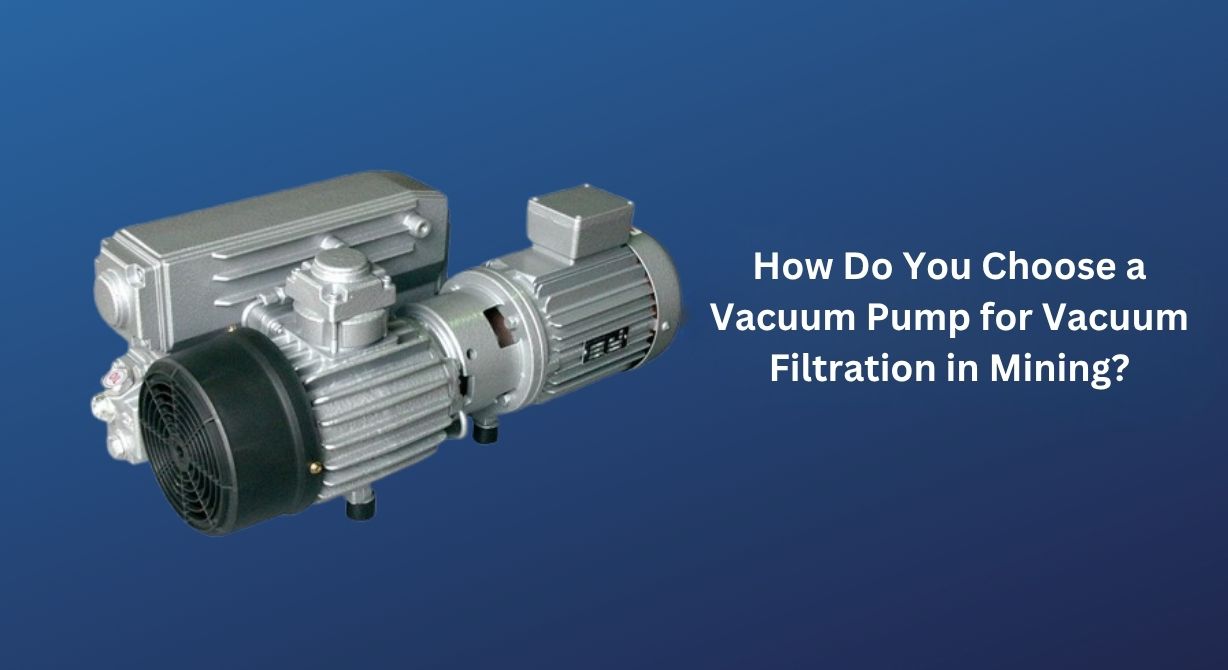
How Can Solid Particles in the Filtrate Affect the Pump?
Mineral particles in mining processes tend to be more abrasive than the process streams found in many other industries. Fine solid particles suspended in the filtrate, if they reach the interior of a vacuum pump, can cause wear on rotor and casing surfaces over time.
To prevent this risk, filtrate is passed through a receiver tank (vacuum receiver) or a cyclone-type separator before reaching the pump, separating most of the liquid and solid content from the airstream. A correctly sized receiver tank both protects the pump from abrasive wear and supports reliable long-term system operation.

Which Pump Series Suits Mining Filtration?
Given mineral filtration's typical profile of high volume and moderate-depth vacuum, Gücüm Pompa's single-stage GMVT/GMPT series is a candidate worth considering for this type of application; according to the catalog, this series reaches capacities of 650–12,000 m³/h and vacuum levels of 40–100 mbar.
Mining is among the sectors Gücüm Pompa serves; for project-specific filtration requirements, you can contact Gücüm Pompa's technical team. Exact model selection should be based on the air demand data from the filter manufacturer and actual process conditions.
What Data Should You Share With Gücüm Pompa's Technical Team When Choosing a Pump?
To select the right pump, sharing the following with Gücüm Pompa's technical team is recommended: filter surface area (m²), air demand per unit area from the filter manufacturer, target vacuum level, solids content and particle size in the filtrate, and the capacity of any existing receiver tank or separator equipment.
As this data becomes clear, it becomes possible to determine both the correctly sized pump series and any additional wear protection measures that might be needed.
Frequently Asked Questions
What Vacuum Level Is Sufficient for Vacuum Filtration?
Moderate vacuum is sufficient for most mineral filtration applications; the exact value depends on the filter type, cake characteristics, and the material's filtration behavior. The filter manufacturer's data should be the basis for the exact requirement.
Do Abrasive Materials Require a Special Pump?
If the filtrate passes through a receiver tank or separator before reaching the pump, removing most of the solid content, a standard liquid ring pump is generally sufficient. For cases with very high abrasiveness, consulting Gücüm Pompa's technical team about additional protective measures is recommended.
Does Pump Capacity Scale Linearly With Filter Area?
That's the general trend, but because cake characteristics and false air ratio also play a role, the exact relationship should be based on the filter manufacturer's air demand calculation.
Should You Choose a Two-Stage Pump Instead of a Single-Stage One?
As covered in our article "Should You Choose a Single-Stage or Two-Stage Liquid Ring Vacuum Pump?", two-stage design is optimized for deeper vacuum. Since mineral filtration is typically volume-priority rather than depth-priority, a single-stage series is the more suitable choice for most applications.
