


Most industrial vacuum needs are met by one of two core technologies: liquid ring vacuum pumps and rotary vane (oil-sealed) vacuum pumps. Since Gücüm Pompa offers both technologies within its own product range, we can approach this choice from a neutral engineering perspective. This article covers the fundamental differences between the two technologies, where each one stands out, and which questions matter for making the right selection.
Table Of Contents
- What Is the Basic Difference Between the Two Technologies?
- Comparing Vacuum Level
- Comparing Vapor and Moisture Tolerance
- Comparing Capacity Range
- Comparing Water Use and Infrastructure Needs
- Comparing Maintenance Needs
- Which Technology Fits Which Processes?
- What Questions Should Guide Your Decision?
- Frequently Asked Questions
What Is the Basic Difference Between the Two Technologies?
As covered in our article "How Does a Liquid Ring Vacuum Pump Work, and Where Does It Make Sense?", liquid ring pumps compress gas using an eccentric rotor and a rotating liquid ring, typically using water as the service liquid. In rotary vane pumps, compression is achieved through the changing volume between sliding vanes mounted on the rotor and the casing; the service liquid is oil, held in a tank mounted on the pump itself.
This structural difference directly determines the vacuum level, vapor tolerance, and capacity range each technology can reach; the sections below cover these differences one by one.
Comparing Vacuum Level
According to Gücüm Pompa's catalog, liquid ring series reach vacuum levels of 33 to 100 mbar depending on design; as covered in our article "Why Does Seal Water Temperature Limit Liquid Ring Pump Vacuum?", this limit stems from the service liquid's vapor pressure. The rotary vane series, meanwhile, can reach down to 0.5 mbar (1 mbar on smaller models) with gas ballast closed, or 1.5 mbar with gas ballast open.
This comparison shows rotary vane pumps reach considerably deeper vacuum than liquid ring pumps; oil's lower vapor pressure compared to water is the fundamental reason for this gap.
Comparing Vapor and Moisture Tolerance
Liquid ring pumps naturally tolerate vapor thanks to their continuously circulating service liquid, with no additional measures needed for that tolerance. In rotary vane pumps, vapor tolerance is provided by the gas ballast feature covered in our article "What Is Gas Ballast and How Does It Help a Rotary Vane Pump Handle Water Vapor?" — but opening that feature shallows the achievable vacuum, and the process's vapor load must not exceed the pump's catalog-rated maximum water vapor capacity.
For processes carrying continuous, heavy vapor loads, liquid ring pumps operate with fewer constraints; for processes with low or well-controlled vapor loads, rotary vane pumps operate with fewer constraints.
Comparing Capacity Range
According to Gücüm Pompa's catalog, liquid ring series offer a wide capacity range starting from 30 m³/h on monoblock models up to 12,000 m³/h on the largest single-stage models. The rotary vane GPM series serves a relatively smaller, small-to-mid-scale range of 11 to 300 m³/h.
This difference shows the two technologies serve different scales of process: large-volume industrial systems generally turn to liquid ring series, while small-scale or laboratory-type applications generally turn to rotary vane series.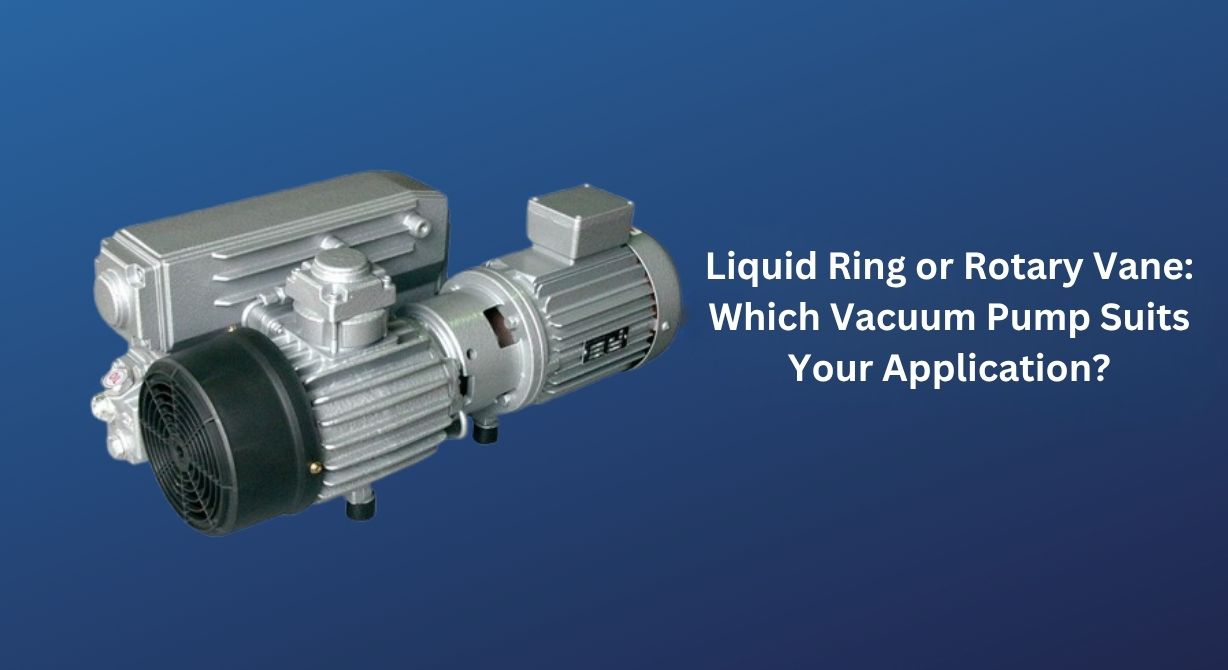
Comparing Water Use and Infrastructure Needs
A standard open-loop liquid ring pump requires a continuous supply of service water; this need can be reduced through the closed-loop units covered in our article "What Separates Water-Circulated and Oil-Circulated Vacuum Units?" Rotary vane pumps, on the other hand, use no water at all; the oil tank sits on the pump itself, requiring no separate water infrastructure or piping.
This characteristic gives rotary vane pumps an advantage in applications with limited water infrastructure, or where installation needs to stay as simple as possible.

Comparing Maintenance Needs
In liquid ring pumps, if open-loop water is used, scaling risk can become a consideration; this risk can be reduced through closed-loop units or controlling water quality. In rotary vane pumps, regular oil checks and periodic oil changes are the basic maintenance requirement; oil quality, when exposed to water vapor, is protected through the correct use of gas ballast, as covered in our article "What Is Gas Ballast?"
Both technologies call for planned, routine maintenance, but the focus of that maintenance differs: liquid ring pumps require attention to water quality and service liquid management, while rotary vane pumps require tracking oil condition.
Which Technology Fits Which Processes?
| Criterion | Liquid Ring Pump | Rotary Vane Pump |
|---|---|---|
| Vacuum level | 33–100 mbar | 0.5–1.5 mbar |
| Capacity | 30–12,000 m³/h | 11–300 m³/h |
| Vapor tolerance | Natural, high | Limited via gas ballast |
| Water use | Generally required | Not required |
| Typical applications | Paper, chemical, mining, power plants, large-scale processes | Vacuum packaging, impregnation, laboratory, roughing |
If a process carries a high vapor load, requires large capacity, or a target vacuum level around 33 mbar is sufficient, a liquid ring pump is generally the more suitable choice. If the process has a dry gas stream, a small-to-mid capacity is sufficient, and a deep vacuum around 0.5 mbar is required, a rotary vane pump offers a more practical solution.
What Questions Should Guide Your Decision?
To determine the right technology, finding clear answers to the following questions is recommended: How much moisture or vapor does the process gas stream carry? What vacuum level is targeted, in mbar? What volumetric capacity (m³/h) is required? Is water infrastructure available at the facility, or is avoiding water use preferred? Does the process run continuously or in batches?
As answers to these questions become clear, the choice between the two technologies resolves itself in most cases; for borderline situations, sharing detailed process data with Gücüm Pompa's technical team is recommended.
Frequently Asked Questions
Can Both Technologies Be Used in the Same Facility?
Yes. Because different process points often have different needs, many facilities use both liquid ring and rotary vane pumps together, for different applications within the same site.
Is a Rotary Vane Pump More Energy Efficient Than a Liquid Ring Pump?
There is no single answer; energy efficiency depends on pump capacity, target vacuum level, operating hours, and service liquid management. In liquid ring pumps, the temperature and flow of the service water, and in rotary vane pumps, the oil condition and gas ballast use, can affect power consumption. A proper comparison requires reviewing specific model data under the same process conditions.
Which Technology Takes Up Less Space?
Rotary vane pumps are generally more compact, since the oil tank sits on the pump itself and no water infrastructure is required. Liquid ring pumps, particularly when closed-loop units are used, may need more space for additional equipment such as a separator tank and heat exchanger.
What Should I Do If I Can't Decide?
Sharing your process data — gas stream, vapor load, target vacuum level, capacity needs — with Gücüm Pompa's technical team lets you evaluate together which technology best fits your specific application.
