


In food production, vacuum pumps form the basis of many processes such as packaging, drying, and degassing. This article covers, in general terms, the role of vacuum in the food sector, hygienic pump requirements, the risk of oil contamination, and pump selection criteria. For the right pump for your application, you can consult the Gücüm Pompa technical team.
Table of Contents
- Why Is a Vacuum Pump Indispensable in the Food Sector?
- How Does Vacuum Packaging Affect Food Preservation?
- In Which Processes Is Vacuum Used in Food Processing?
- How Does a Hygienic Vacuum Pump Differ from a Standard Pump?
- Which Hygiene Standards Apply in Food Vacuum Systems?
- How Does the Risk of Oil Contamination Affect Food Applications?
- What Criteria Are Prioritized in Vacuum Pump Selection for Food Facilities?
- How Does Vacuum Pump Maintenance Affect Food Safety?
- Why Is Manufacturer Support Decisive in Hygienic Vacuum Pump Selection?
- Frequently Asked Questions
Why Is a Vacuum Pump Indispensable in the Food Sector?
In the food sector, the vacuum pump is a critical production equipment that directly determines product quality and shelf life. Oxygen is the main factor that accelerates spoilage, color change, flavor loss, and microbiological growth in foods; vacuum protects the food biologically and chemically by removing this oxygen from the environment. In many food processing lines, vacuum is an indispensable part of production standards.
The pumps used in food vacuum packaging applications must meet requirements far beyond standard industrial applications. Every surface and every gas flow that may come into direct or indirect contact with the product must comply with hygiene standards, food regulations, and international certification requirements. The correct pump selection directly affects not only production efficiency but also the food safety of the final product.
How Does Vacuum Packaging Affect Food Preservation?
Vacuum packaging is based on the principle of removing most of the air, and therefore the oxygen, inside the package. Reducing the oxygen level to this extent greatly slows the growth of aerobic bacteria and mold fungi; it prevents lipid oxidation and suppresses enzymatic browning reactions. This protective mechanism provided by vacuum can noticeably extend the shelf life of meat, cheese, delicatessen products, fish, and ready-to-eat foods; the extension achieved varies with product type, packaging material, and storage conditions.
The effectiveness of vacuum packaging depends directly on the stability of the applied vacuum level. The time to reach the target vacuum per cycle inside the packaging machine determines the line speed and thus the production capacity. A pump with insufficient vacuum capacity either cannot reach the target pressure or lengthens the cycle time and creates a bottleneck in the line. In food vacuum packaging lines, the pump must fully meet the production requirements in terms of both flow capacity and vacuum depth.
In Which Processes Is Vacuum Used in Food Processing?
Although vacuum is most commonly used in retail and industrial scale food packaging, it plays a critical role in a much wider range of food processing. In vacuum drying processes, moisture can be removed without exposing the product to high heat; this method can give better results than oven drying in terms of preserving vitamins and aroma profile. Lyophilization, or freeze-drying, is an advanced preservation method that requires extremely deep vacuum and is used in premium food products.
In vacuum cooking and sous-vide applications, food is processed in vacuum packaging with precise temperature control. In the vacuum impregnation technique, flavor and functional components can be introduced into porous food structures with the help of vacuum. Vacuum degassing is applied in filling lines to prevent foam formation; this step is decisive for product quality in the production of marmalade, fruit juice, and dairy products. A high-performance and hygienic vacuum pump is at the common denominator of all these applications.
How Does a Hygienic Vacuum Pump Differ from a Standard Pump?
A hygienic vacuum pump differs fundamentally from a standard industrial pump in terms of design, material, and certification. All surfaces that may come into contact with food are designed to be smooth, cornerless, and easily cleanable to prevent bacterial accumulation. The use of AISI 316L stainless steel or equivalent food-approved material in the body and internal parts is mandatory. Seals and sealing elements must be made of FDA or EHEDG approved materials.
Another critical element of hygienic design is suitability for clean-in-place (CIP) and sterilize-in-place (SIP) applications. In food facilities, the pump is expected to withstand these cleaning processes, which are carried out without disassembling the equipment. These features are not found in standard industrial pumps; therefore, using standard pumps in food applications creates an unacceptable risk in terms of both food safety and regulatory compliance.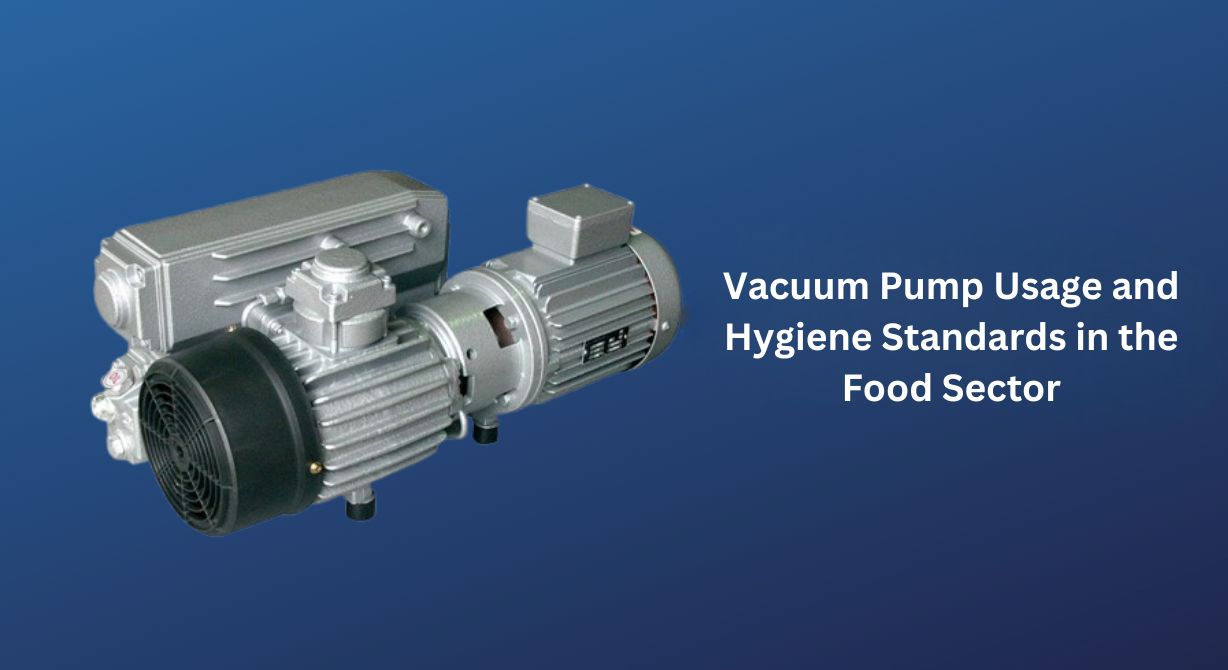
Which Hygiene Standards Apply in Food Vacuum Systems?
The main international standards and directives that must be met in food vacuum pump applications are: EHEDG (European Hygienic Engineering and Design Group) guidelines, 3-A Sanitary Standards, FDA 21 CFR regulations, and European Food Safety Authority EFSA requirements. Food facilities operating in Türkiye must also comply with the Turkish Food Codex and Ministry of Agriculture and Forestry regulations.
Food safety management system certifications such as ISO 22000 and FSSC 22000 require that the equipment used is also compatible with these systems. How the vacuum pump is positioned in the HACCP (Hazard Analysis and Critical Control Points) analysis, what contamination risks it carries, and how these risks are controlled must be clearly documented. Failure to present complete equipment documents during audits is evaluated as a serious non-compliance that jeopardizes the production permit.
How Does the Risk of Oil Contamination Affect Food Applications?
Oil-type vacuum pumps can mix oil vapor and aerosol particles into the exhaust gas. The presence of oil particles in the packaging environment or process gas that comes into direct contact with food both chemically contaminates the product and leads to violation of legal regulations. Standard mineral pump oils are generally not food approved; therefore, the use of standard oil-type pumps is not suitable in applications with a risk of contact with food.
There are two main approaches in food applications: either special oil-type pumps using food-approved oil and equipped with high-efficiency oil retention filters in the exhaust line are preferred, or oil-free dry-type or liquid (water) ring hygienic vacuum pumps are used. The second approach is preferred because it significantly reduces the risk of oil-related contamination. In both cases, it is recommended that the selection be made in cooperation with a food safety specialist and the pump manufacturer.

What Criteria Are Prioritized in Vacuum Pump Selection for Food Facilities?
The first step in the selection process is to determine the level of contact the application has with food. There is a significant difference in hygiene requirements between applications where pump gas enters the packaging environment directly and applications where it operates only through a remote pipeline. The higher the level of contact, the stricter the certification requirements and material specifications should be.
Pumping capacity and compatibility with line speed is another priority criterion. Food packaging lines can produce hundreds of packages per hour; the vacuum time per cycle is measured in seconds. The pump's ability to reach the required vacuum level at this speed and consistently directly determines production efficiency. In addition, energy consumption, noise level, ease of cleaning, spare parts availability, and after-sales technical support are among the criteria that should not be ignored in the selection process.
How Does Vacuum Pump Maintenance Affect Food Safety?
A vacuum pump that is not regularly maintained can pose a silent threat to food safety. Worn seals and sealing elements can cause gas leakage or the entry of outside air into the system; filter clogging reduces pumping capacity and degrades packaging quality; bacteria and algae formation can become a source of contamination in wet-type systems. All these situations lead to results that threaten both product quality and consumer safety.
In food facilities, vacuum pump maintenance should be planned strictly according to the periods determined by the manufacturer, maintenance records should be archived as part of HACCP documents, and the consumables used during maintenance should be food-approved. A planned maintenance program both extends equipment life and serves as an important proof documenting the sustainable reliability of production during audits.
Why Is Manufacturer Support Decisive in Hygienic Vacuum Pump Selection?
Gücüm Pompa applies its experience in vacuum pump manufacturing to applications that address the requirements of the food sector. Dry (oil-free) and liquid ring vacuum pump options can be evaluated for food packaging lines, vacuum drying, and food processing. Because material, seal, and certification requirements vary by application, it is recommended that these details be clarified together with the Gücüm Pompa technical team at the project stage.
In the selection process, technical consultancy, field support after installation, and spare parts supply speed play a decisive role in pump selection for food production facilities. In the food sector, where production downtime is costly, fast and reliable service support is as important as pump performance. The Gücüm Pompa technical team is available for support with technical consultancy, spare parts, and service, both during selection and afterwards.
Frequently Asked Questions
What Vacuum Level Is Sufficient for Food Packaging Lines?
In standard food vacuum packaging applications, a vacuum level in the range of 2 to 10 mbar is usually sufficient. For sensitive products or applications targeting long shelf life, values below 1 mbar may be preferred. The target vacuum level is a parameter that should be determined together with a food technologist according to the product type and packaging material.
Can Oil-Type Pumps Never Be Used in Food Applications?
Special oil-type pumps using food-approved oil and equipped with high-efficiency exhaust filters can be preferred in some applications. However, in systems with a risk of direct product contact, dry-type or liquid (water) ring hygienic pumps are a safer option. The choice should be made together with HACCP analysis and the technical support of the pump manufacturer.
What Are the Features of Vacuum Pumps Suitable for CIP Cleaning?
In CIP-compatible vacuum pumps, all internal surfaces must be smooth and cornerless, the materials used must be resistant to cleaning chemicals and high temperature, and it must be possible to deliver the cleaning solution to the system without disassembly. EHEDG certification is a strong indication that these requirements have been independently verified.
What Is the Position of the Vacuum Pump in HACCP Analysis?
The vacuum pump, like any equipment that can deliver gas to the packaging environment, should be evaluated as a potential source of contamination in HACCP analysis. If defined as a critical control point, monitoring procedures, corrective action plans, and verification records must be prepared.
How Often Should Vacuum Pumps Be Maintained in the Food Sector?
Maintenance frequency depends on pump type, usage intensity, and manufacturer recommendations. The intervals for filter checks, mechanical inspections, and comprehensive maintenance should be set according to the manufacturer's maintenance instructions and the facility's HACCP plan. In food facilities, recording maintenance in the HACCP file may be considered a legal requirement. The Gücüm Pompa technical team provides technical guidance on this matter.
