


Liquid ring vacuum pumps are the go-to choice in many processes thanks to their vapor tolerance and low maintenance needs, but the vacuum level they can reach has a real limit. In chemical, pharmaceutical, and food processing, some processes call for a vacuum deeper than a liquid ring pump can achieve on its own. That's where a vacuum booster comes in. This article covers what a vacuum booster is, why it can't run alone, and how pairing it with a liquid ring pump reaches vacuum levels neither could achieve independently.
Table Of Contents
- What Is a Vacuum Booster?
- Why Can't a Vacuum Booster Run on Its Own?
- How Do a Vacuum Booster and a Liquid Ring Pump Work Together?
- What Vacuum Level Does a Single-Stage Booster Reach?
- When Should You Choose a Two-Stage Booster System?
- How Is Overload Risk Managed in Booster Systems?
- Which Processes Use a Vacuum Booster?
- What Should You Consider When Selecting a Booster System?
- Frequently Asked Questions
What Is a Vacuum Booster?
A vacuum booster is a supplementary unit added ahead of an existing vacuum pump — on the process side — to push a system's achievable vacuum level even deeper. It's typically a positive-displacement device built around two lobed rotors that never touch each other, kept in sync by external timing gears. Because there's no contact between the rotors or with the casing, and no internal compression, a booster works essentially by "transferring" gas from one side to the other rather than compressing it internally.
The key advantage of this design is a very high pumping speed at low pressures. A liquid ring pump loses suction capacity as the vacuum level gets deeper, whereas a booster maintains high volumetric flow in that same low-pressure region. This is why a booster is brought in as the system's "final stage," switched on right at the point where vacuum is deepest.
Why Can't a Vacuum Booster Run on Its Own?
The absence of internal compression is also the booster's biggest constraint: once the ratio between inlet and outlet pressure (the compression ratio) exceeds a certain limit, back-leakage between the rotors increases, the motor becomes overloaded, and temperature rises quickly. If a booster tried to discharge directly to atmosphere (roughly 1013 mbar), the ratio between its low inlet pressure and atmospheric pressure would be far too large, pushing the unit outside its safe operating range.
For that reason, a booster always operates alongside a "backing pump" that keeps its outlet pressure below a certain level. A liquid ring vacuum pump plays exactly that role: it accepts the gas the booster discharges and pushes it out to atmosphere across a much larger, but manageable, pressure ratio. This lets the booster stay within its own safe compression-ratio range at all times.
How Do a Vacuum Booster and a Liquid Ring Pump Work Together?
When a booster system starts up, the sequence matters. The liquid ring vacuum pump runs first, on its own, bringing system pressure down from atmospheric level. With Gücüm Pompa booster applications, once the system reaches a certain vacuum pressure value — in the range of 50–80 mbar — the booster is switched on.
This switch-on point matters because the booster is held back until inlet pressure drops into that range; at a higher inlet pressure, the booster's compression ratio could exceed safe limits. Once pressure falls below that threshold, the booster starts running, and the system reaches a depth the liquid ring pump could never achieve alone. Combining the two products this way delivers a performance range that neither a liquid ring pump by itself, nor a booster by itself, could provide — by pairing the strengths of two different technologies.
What Vacuum Level Does a Single-Stage Booster Reach?
In Gücüm Pompa single-stage booster applications, the system can reach roughly 5–10 mbar absolute, depending on operating conditions. That's noticeably deeper than the 33–40 mbar range a liquid ring pump can reach on its own, and it demonstrates concretely what value the booster adds to the system.
Reaching this level depends on the process gas load, system leaks, and correct equipment sizing — so the "5–10 mbar" figure should be understood as an achievable range under the right conditions, not a fixed guarantee.
When Should You Choose a Two-Stage Booster System?
The 5–10 mbar level a single-stage booster reaches may not be sufficient for some processes. In that case, two-stage booster systems — two boosters connected in series — come into play. A Gücüm Pompa two-stage booster system can reach values down to 1–5 mbar.
In a two-stage setup, each booster is designed to stay within its own safe compression ratio: the first stage picks up from where the liquid ring pump leaves off and lowers the pressure further, while the second stage starts from that lower inlet pressure and pushes the vacuum considerably deeper. This staged approach splits a compression ratio that a single booster couldn't safely handle into two manageable steps.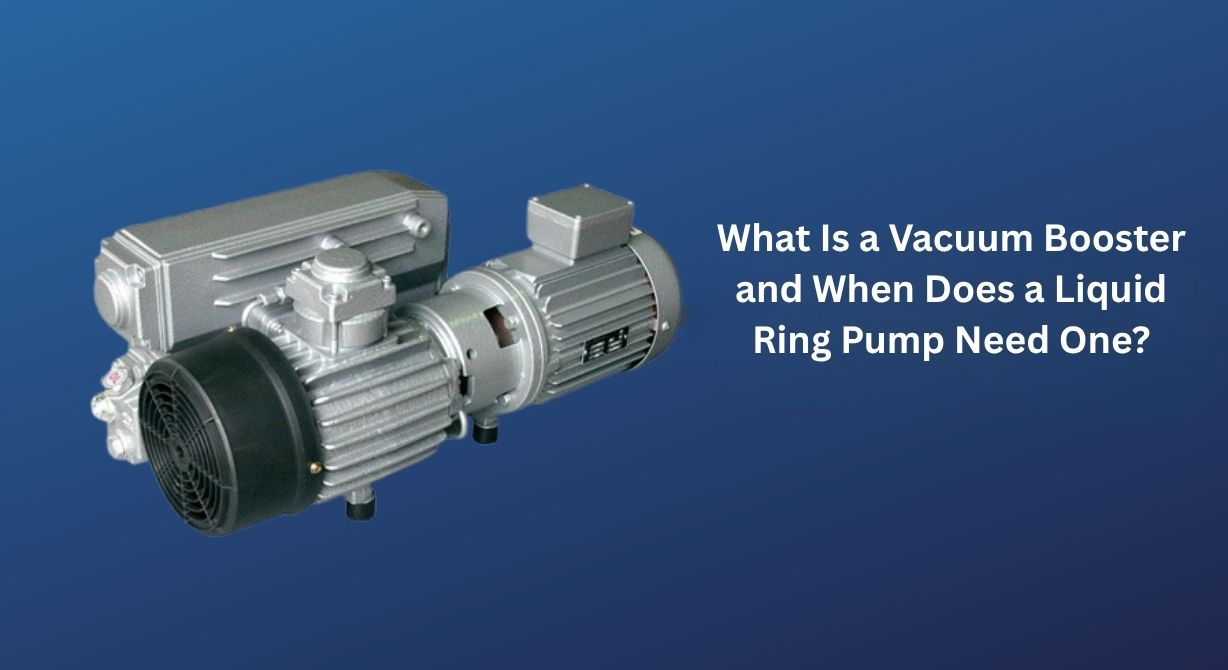

How Is Overload Risk Managed in Booster Systems?
Under general engineering principles for Roots-type booster units, if inlet pressure runs higher than expected — for example, if the booster is switched on before the system has been sufficiently evacuated — the compression ratio can exceed safe limits, and motor current and temperature can rise quickly. In industrial practice, this risk is typically managed through pressure-triggered automatic switch-on logic: the booster only starts running once inlet pressure has dropped below a defined threshold.
Running a booster-and-backing-pump system with the right control logic — pressure switches, time-delayed start-up, or continuous pressure monitoring — helps protect equipment life and reduces the risk of unexpected downtime. Because these control details are project-specific, they should be worked out with the pump manufacturer during installation.
Which Processes Use a Vacuum Booster?
Booster-supported systems are chosen for processes requiring deeper vacuum than a liquid ring pump alone can provide. These process types generally include:
- Low-temperature distillation: Distilling heat-sensitive materials under deep vacuum to lower their boiling point.
- Intensive drying and degassing: Applications where gas and moisture need to be removed from a material at pressures far below atmospheric.
- Chemical process and reaction control: Reactions that only achieve the desired efficiency at very low pressure.
- Vacuum testing and simulation applications: Situations requiring a stable, very deep vacuum environment.
For deep vacuum applications in sectors such as chemical, food and pharmaceutical processing, the need for a booster system is assessed according to project-specific conditions. You can contact the Gücüm Pompa technical team for help selecting a system suited to your application.
What Should You Consider When Selecting a Booster System?
Selecting the right booster system requires clarifying the following:
- Target final vacuum level: Determines whether a single-stage or two-stage system is required.
- Process gas load: Determines the correct booster capacity for the gas volume it needs to handle.
- Backing pump capacity: The liquid ring pump must also be sized adequately for the booster to operate efficiently.
- Switch-on and control logic: Pressure measurement points and automation are decisive for the system's safe operation.
Sharing these parameters accurately with the pump manufacturer ensures both the booster's safe operation and reliable achievement of the target vacuum level.
Frequently Asked Questions
Can a Vacuum Booster Discharge Directly to Atmosphere?
Generally no. Because the ratio between a booster's inlet and outlet pressure is limited, discharging directly to atmosphere would push it outside its safe operating range. That's why it needs a backing pump — such as a liquid ring pump — to keep outlet pressure low.
When Do You Need a Booster System?
If the vacuum level a process requires falls below what a liquid ring pump alone can achieve — for example, the 33–40 mbar range — adding a booster should be considered. The exact need is determined by examining the process's gas load and target pressure.
What If a Single-Stage Booster Isn't Enough?
If the level a single-stage booster reaches (roughly 5–10 mbar) isn't sufficient, a two-stage system — two boosters connected in series — can bring the system down to the 1–5 mbar range. Each stage in this system is designed to operate within its own safe compression ratio.
What Problems Can Arise From Switching On a Booster Too Early?
If the booster is switched on before the system has been sufficiently evacuated, inlet pressure remains high, and the compression ratio can exceed safe limits — leading to a rapid rise in motor current and temperature. For this reason, boosters are typically controlled to switch on only after the system reaches a certain vacuum level.
