


A flat hydraulic press can't apply even pressure to every point of a curved furniture part; the more complex the curve, the sooner a flat steel platen loses contact with the surface. Vacuum pressing flips that problem around: a flexible membrane presses against the part's surface — flat or curved, it makes no difference — with atmospheric pressure applied evenly across the whole area.
Table Of Contents
- What Is Vacuum Pressing, and How Does It Differ From a Hydraulic Press?
- How Does a Vacuum Bag Work in a Veneering Process?
- Why Does Vacuum Pressing Stand Out on Curved Surfaces?
- How Does Membrane Pressing Relate to Door and Kitchen Panel Wrapping?
- How Deep a Vacuum Does Pressing Actually Need?
- What Data Should Be Shared for the Right Pump Selection?
- Frequently Asked Questions
What Is Vacuum Pressing, and How Does It Differ From a Hydraulic Press?
Vacuum pressing works by placing the part to be laminated under a flexible membrane and drawing out the air between the membrane and the part with a vacuum pump. As the air empties out, atmospheric pressure pushes the membrane against the part's surface, applying even pressure across the whole area — indentation, protrusion, or curve, it makes no difference.
A classic hydraulic press applies fixed pressure between two flat platens; it works well when the part is flat, but once a curved or recessed geometry is involved, the platen can't make full contact with the surface, leaving weak adhesion in some spots. Vacuum pressing removes that limitation because the membrane conforms to every contour of the part.
How Does a Vacuum Bag Work in a Veneering Process?
In veneering, a thin sheet of wood is placed on a glue-coated substrate and put inside a vacuum bag. As air is drawn out of the bag, the veneer sheet presses firmly onto the substrate below, and that pressure is held throughout the glue's curing time. Some systems combine this with a heated platen to shorten curing time.
Keeping vacuum level steady matters here; a fluctuation in pressure can leave the veneer under-pressed at certain points, leading to bubbling or delamination over time.
Why Does Vacuum Pressing Stand Out on Curved Surfaces?
For non-flat geometries — chair backs, curved cabinet doors, organically shaped design parts — being able to apply even pressure without a rigid mold (or with only a simple base form) makes vacuum pressing a practical solution for this kind of production. Producing the same part on a hydraulic press generally requires an expensive mold shaped specifically to that part's geometry.
How Does Membrane Pressing Relate to Door and Kitchen Panel Wrapping?
In furniture manufacturing, wrapping PVC foil or melamine onto MDF-cut door and kitchen cabinet surfaces is done with a specialized type of vacuum pressing called a membrane press. This equipment can wrap the foil continuously, in a single operation, into the grooves, channels, and profile details on a door's surface — because the membrane reaches into even the smallest recess through vacuum.
This application sits right at the intersection of forestry industry and furniture manufacturing, and it's one of the most common uses of vacuum in that space.

How Deep a Vacuum Does Pressing Actually Need?
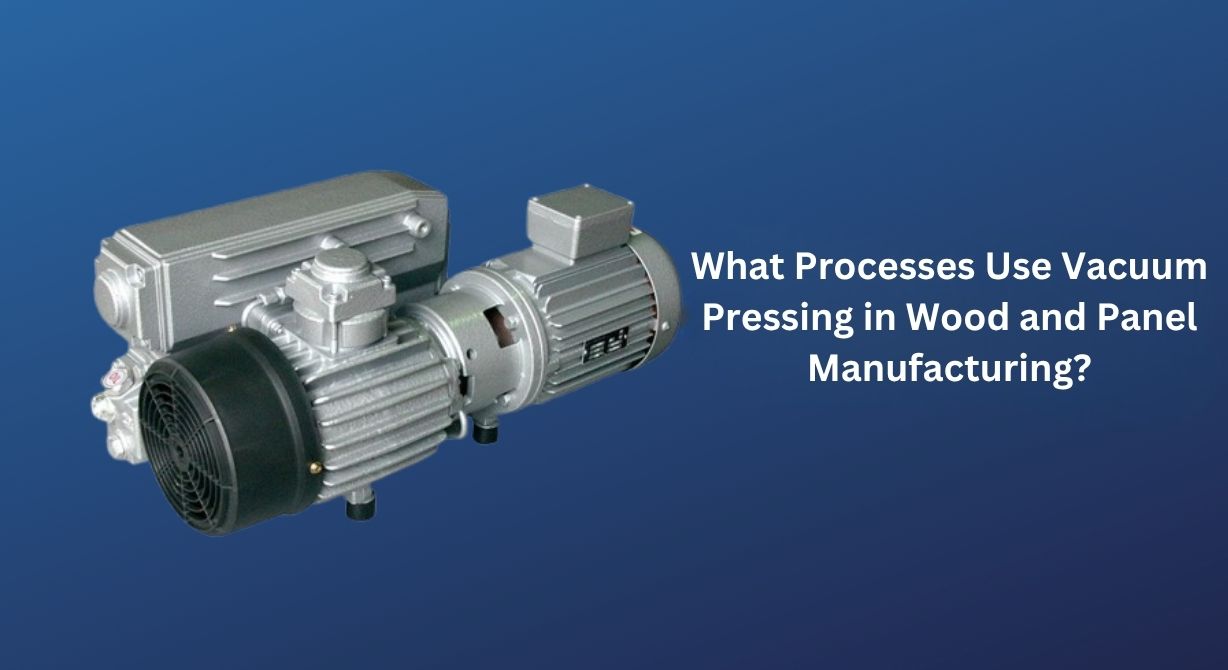
The goal in vacuum pressing isn't an extremely deep vacuum — it's removing most of the air between the membrane and the part so atmospheric pressure can take effect; a moderate vacuum level is generally enough. As covered in our comparison article "Liquid Ring or Rotary Vane: Which Vacuum Pump Suits Your Application?", the level liquid ring pumps standardly reach is sufficient for most applications of this kind.
What Data Should Be Shared for the Right Pump Selection?
The total surface area of the press table or bag, the target evacuation time (how quickly the cycle needs to reach vacuum), and the number of presses running simultaneously on the line are the core data points for determining correct pump capacity. On a continuous production line, multiple presses demanding vacuum at the same time directly affects the capacity calculation.
Frequently Asked Questions
Can Vacuum Pressing Fully Replace Hydraulic Presses?
No, the two methods serve different needs. For flat, high-volume production, a hydraulic press is generally faster and more economical; for curved or complex geometries, vacuum pressing offers an advantage.
What Happens If the Membrane Tears?
A torn membrane causes vacuum loss and stops pressing; this makes periodic membrane inspection and replacement part of the production process. This should be managed according to the equipment's own operating manual.
Can One Pump Feed Multiple Presses?
Possible if capacity allows; but whether the presses run simultaneously and each one's actual vacuum demand should be evaluated against the criteria covered in our article "Central Vacuum System or Point-of-Use Pumps: Which Is More Efficient?"
Which Gücüm Pompa Series Is Recommended for Vacuum Pressing?
The suitable series is determined together with our technical team. Once the press surface area, target evacuation time and number of simultaneously running presses are shared, the team selects the series that fits the required vacuum level, capacity and operating conditions.
