


For processes that require a liquid ring vacuum pump to run on a closed loop, Gücüm Pompa offers two unit types: water-circulated and oil-circulated vacuum units. Both serve the same basic purpose — keeping service liquid circulating within the system for more controlled operation than an open-loop setup — but the difference in the service liquid they use significantly changes the vacuum level they reach, the process types they suit, and their maintenance needs. This article covers the differences between these two unit types and where each one stands out.
Table Of Contents
- What Is the Basic Difference Between Water-Circulated and Oil-Circulated Vacuum Units?
- Why Does an Oil-Circulated Unit Reach a Deeper Vacuum Than a Water-Circulated One?
- Why Is a Water-Circulated Unit Preferred for Processes With Heavy Water Vapor?
- Why Does an Oil-Circulated Unit Have an Advantage With High-Temperature Gases?
- How Do the Two Units Compare on Water Consumption and Scaling?
- What Role Does the Vacuum Tank Play in a Water-Circulated Unit?
- Which Unit Should You Choose for Which Situation?
- Frequently Asked Questions
What Is the Basic Difference Between Water-Circulated and Oil-Circulated Vacuum Units?
An oil-circulated vacuum unit has the liquid ring pump use oil instead of water as its service liquid, and that oil is cooled within a closed loop and reused continuously. A water-circulated vacuum unit continues to use water as the service liquid, but instead of continuously supplying fresh water in an open loop, it cools and recirculates that water through a closed loop via a separator tank and heat exchanger.
Both units share the same basic goal: keeping the service liquid within the system for a more controlled, less liquid-hungry operation than an open loop. But whether that liquid is water or oil is the source of the performance and application differences covered in the sections below.
Why Does an Oil-Circulated Unit Reach a Deeper Vacuum Than a Water-Circulated One?
As covered in our article "How Does a Liquid Ring Vacuum Pump Work?", the vacuum level a liquid ring pump can reach is directly tied to the service liquid's vapor pressure: the warmer the service liquid and the higher its vapor pressure, the shallower the achievable vacuum stays. Oil's vapor pressure is noticeably lower than water's at the same temperature, so an oil-circulated unit can reach a considerably deeper vacuum than a water-circulated one.
This relationship shows up in concrete figures on Gücüm Pompa's own product pages: the oil-circulated vacuum unit operates at high performance down to 10 mbar absolute pressure, while the water-circulated vacuum unit reaches absolute vacuum pressure down to 33 mbar with a 15°C service water temperature. The gap is a natural consequence of the two service liquids' different vapor pressure properties.
Why Is a Water-Circulated Unit Preferred for Processes With Heavy Water Vapor?
As stated on Gücüm Pompa's product page, the water-circulated vacuum unit provides "the most ideal solution" for processes involving heavy water vapor. The vapor entering the pump condenses within the system and is discharged as water, and that water does not damage the pump.
The logic here is fairly simple: if the vapor coming from the process is already water vapor, using water as the service liquid too eliminates any risk of two different liquids mixing with each other. Running the same process through an oil-circulated unit could let condensed water mix into the oil, creating a risk similar to the oil contamination issue we covered for rotary vane pumps in our article "What Is Gas Ballast?" Matching the service liquid to the type of vapor already in the process removes that risk entirely.
Why Does an Oil-Circulated Unit Have an Advantage With High-Temperature Gases?
Gücüm Pompa's product page states that the oil-circulated unit "operates at high vacuum levels even with high ambient temperatures and high-temperature gases being pumped." This is because oil's vapor pressure rises more slowly with increasing temperature than water's does — so as ambient or gas temperature climbs, an oil-circulated unit's performance is affected less than a water-circulated one's would be.
Continuous oil circulation also keeps the pump's internal parts well lubricated, giving it a long service life against wear. The unit's own technical characteristics also deliver quiet operation — a further advantage in installations where noise is a concern.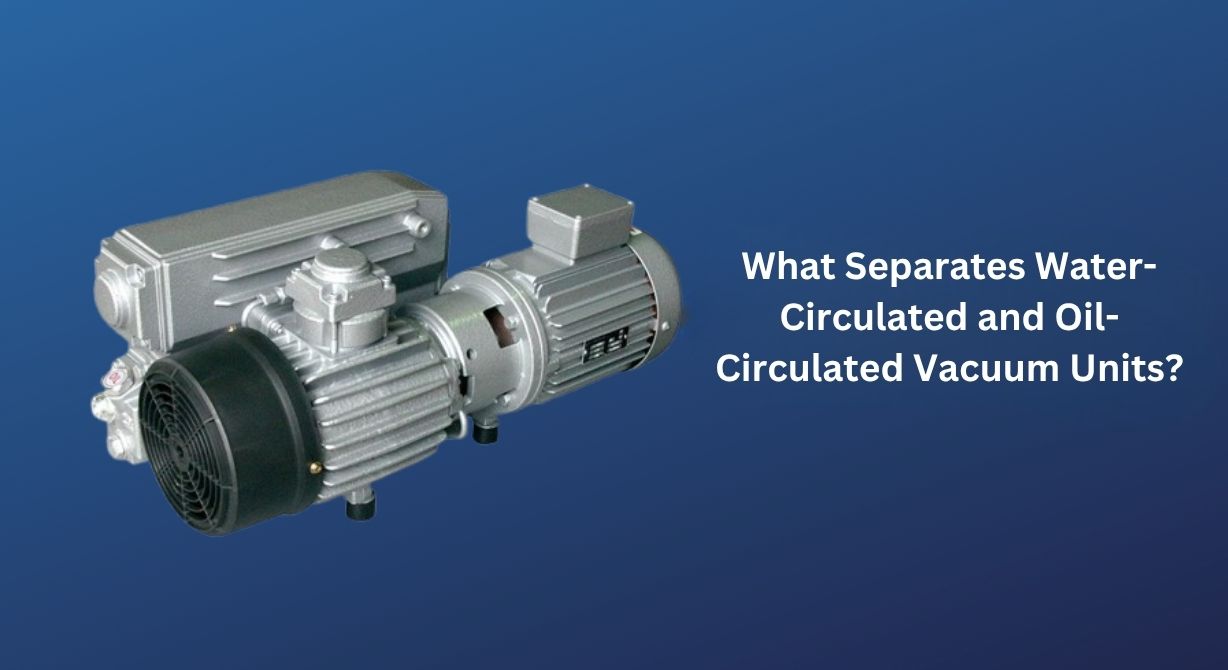
How Do the Two Units Compare on Water Consumption and Scaling?
Because the oil-circulated unit never uses water the way traditional open-loop methods do, water consumption and the risk of scale build-up are eliminated from the outset. The water-circulated unit still uses water, but in far smaller quantities than an open loop would require; the separator tank and heat exchanger cool and reuse water within the system, substantially reducing the need for a continuous fresh-water supply.
On scaling risk specifically, an oil-circulated unit removes this issue by design, while a water-circulated unit still carries some scaling risk depending on water quality — though closed-loop operation reduces that risk considerably compared to an open loop.

What Role Does the Vacuum Tank Play in a Water-Circulated Unit?
The vacuum tank in a water-circulated vacuum unit keeps foreign objects and liquids coming from the suction line from reaching the pump directly. It also gives the system a vacuum reserve that reduces sudden fluctuations in vacuum pressure — a particular benefit in applications with batch or variable process flow.
Tank design and tank details for the oil-circulated unit vary by model; get this information directly from the relevant model's manual or from Gücüm Pompa's technical team.
Which Unit Should You Choose for Which Situation?
An oil-circulated vacuum unit is generally the better choice when:
- The target vacuum level needs to go below 33 mbar (down to around 10 mbar).
- Eliminating water use entirely is a priority, due to scaling concerns or limited water supply.
- Ambient or gas temperature runs high, and stable performance under those conditions is required.
A water-circulated vacuum unit stands out when:
- The process gas stream carries a significant amount of water vapor.
- A target vacuum level around 33 mbar is sufficient.
- Water supply is available, and a closed-loop solution that uses far less water than an open loop is preferred.
Frequently Asked Questions
Does an Oil-Circulated Unit Always Reach a Deeper Vacuum Than a Water-Circulated One?
That's the general trend, because oil has a lower vapor pressure than water. According to Gücüm Pompa's catalog, the oil-circulated unit can reach absolute vacuum pressure down to 10 mbar, while the water-circulated unit reaches down to 33 mbar.
Does a Water-Circulated Unit Need Less Maintenance Than an Oil-Circulated One?
Maintenance needs vary depending on the service liquid used and process conditions. For exact maintenance intervals and procedures, consulting Gücüm Pompa's operating manual or technical team is recommended.
Can Both Unit Types Be Used on the Same Process?
Different unit types can be used on different process lines. But for a single line, the right choice should be based on that line's own conditions — vapor load, temperature, and target vacuum level — settling on one unit type accordingly.
How Often Does the Oil in an Oil-Circulated Unit Need to Be Changed?
The oil change interval varies by model and process conditions; get this information directly from the relevant model's manual or from Gücüm Pompa's technical team.
