


Another key decision when selecting a liquid ring vacuum pump is whether to go with a monoblock design or a coupled one (two-stage or single-stage). Monoblock design stands out especially in small and mid-capacity applications, thanks to easier installation and lower maintenance needs. This article covers where a monoblock design gives you an advantage over coupled models, where those advantages come from, and where the design reaches its limits.
Table Of Contents
- What Is a Monoblock Design, and How Does It Differ From a Coupled Design?
- What Advantages Come From Removing the Coupling?
- Why Does a Monoblock Design Take Up Less Space?
- How Does a Monoblock Design Simplify Installation and Alignment?
- What Are the Maintenance Advantages of a Monoblock Design?
- Why Does a Monoblock Design Have a Capacity Limit?
- When Should You Choose a Coupled Design Instead?
- Frequently Asked Questions
What Is a Monoblock Design, and How Does It Differ From a Coupled Design?
In a coupled liquid ring vacuum pump, the pump rotor is mounted on its own shaft, and that shaft connects to the motor shaft through a separate coupling. The motor and pump sit as two independent bodies, and the alignment between them is maintained through that coupling. In a monoblock design, this separation disappears entirely: the pump rotor is mounted directly on an extended motor shaft. There's no separate pump shaft, no coupling, and no alignment procedure needed between the two.
Gücüm Pompa monoblock series have fewer parts and no coupling connection, which sums up the core characteristic of this design. Because the rotor is mounted directly on the motor shaft, the shaft never comes into contact with the pumped medium on the motor side.
What Advantages Come From Removing the Coupling?
A coupling is a mechanical component that connects two shafts while tolerating small axial and angular misalignment between them. In a coupled system, keeping this connection working properly requires aligning the motor and pump shafts within a defined tolerance; over time, vibration, thermal expansion, or foundation settling can throw that alignment off, requiring re-adjustment.
In a monoblock design, this alignment requirement disappears along with the coupling itself. Because the rotor is mounted directly on the motor shaft, there's no concept of "alignment" between two shafts — the motor is manufactured as an already-aligned single unit. This greatly simplifies both the initial installation process and the periodic checks needed during operation.
Why Does a Monoblock Design Take Up Less Space?
In a coupled system, physical space needs to be reserved between the motor and pump for the coupling, a coupling guard needs to be installed, and the two separate bodies need to sit on their own mounting feet. This requires a certain length on the baseplate.
Because a monoblock design behaves as a single integrated unit, this gap isn't needed. Thanks to its compact structure, it occupies less space. This becomes a concrete advantage particularly in facilities with limited layout space, or in applications where multiple pumps need to be positioned side by side.
How Does a Monoblock Design Simplify Installation and Alignment?
Installing a coupled pump involves mounting the motor and pump separately on the baseplate, connecting the coupling, and then performing shaft alignment. This alignment process typically requires specialized measurement equipment — such as a dial indicator or laser alignment tool — and if done incorrectly, can lead to vibration, noise, and premature wear over time.
In a monoblock design, this step disappears entirely. Since the pump housing is mounted directly onto the motor's extended shaft, installation is simply a matter of securing the motor to the baseplate. This shortens installation time and significantly reduces the risk of a field alignment error.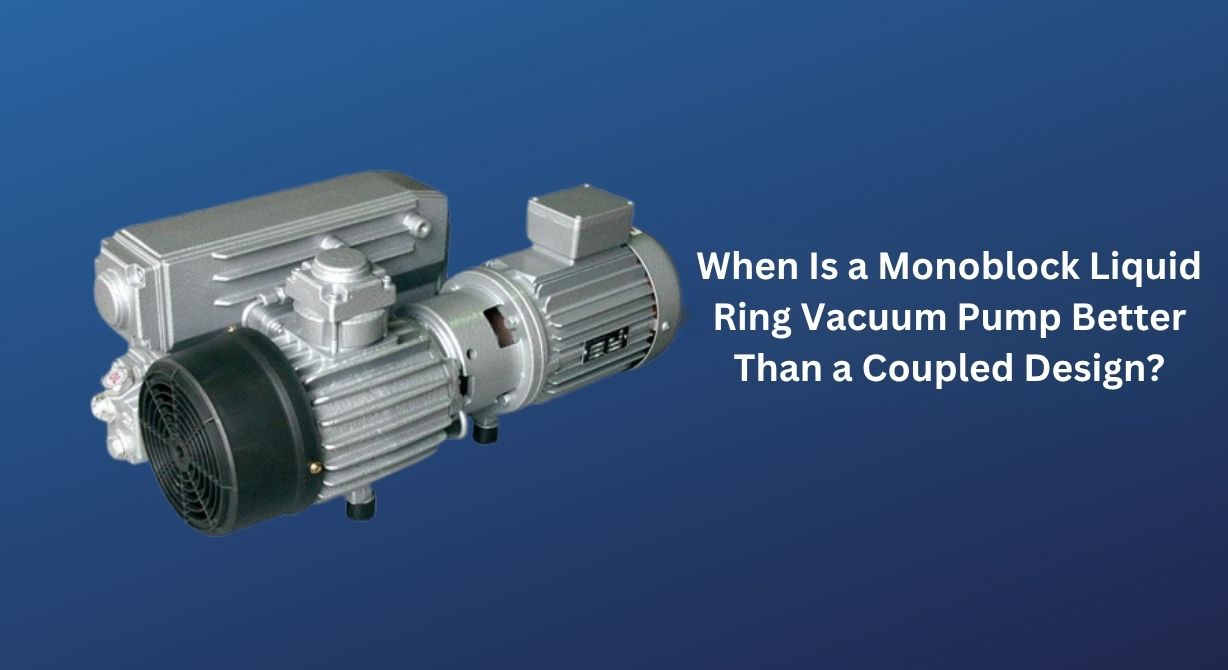
What Are the Maintenance Advantages of a Monoblock Design?
In a coupled system, the coupling itself is a component that requires regular inspection: wear, degradation of rubber or elastomer elements, and loss of alignment all need periodic monitoring. In a monoblock design, this component is eliminated entirely, reducing the number of items a maintenance program needs to track.
The low maintenance needs of monoblock pumps reflect this general ease of maintenance. In addition, the absence of metallic contact between rotating parts and the casing, along with sealing provided by a mechanical seal, helps the monoblock series run with low wear, just as with the other liquid ring pump families.

Why Does a Monoblock Design Have a Capacity Limit?
The advantages a monoblock design brings come with a trade-off: because the rotor is mounted directly on the motor shaft, the rotor's weight and size add an extra mechanical load onto the motor's own shaft and bearing system. As a result, monoblock design is, in practice, not suitable for rotors above a certain size — a very large, heavy rotor can overload the motor bearings and lead to premature failure.
This limit is visible in Gücüm Pompa's catalog: the monoblock GMVP/GMVX series is limited to a capacity range of 30–375 m³/h and a maximum vacuum of 33 mbar. Applications requiring higher capacity or deeper vacuum call for the coupled two-stage or single-stage series instead.
When Should You Choose a Coupled Design Instead?
A coupled design becomes the more suitable choice than a monoblock design when:
- The process requires a capacity above 375 m³/h.
- The target vacuum level needs to go deeper than the 33 mbar limit the monoblock series offers — in which case a two-stage design should be considered.
- Managing motor and pump maintenance or replacement independently is a priority; in a coupled system, the motor can be removed and replaced separately from the pump.
If any of these three conditions apply, it may be worth trading the compactness and easy installation a monoblock design offers for the capacity or vacuum depth the application actually needs.
Frequently Asked Questions
Is a Monoblock Pump Cheaper Than a Coupled Pump?
Having fewer parts — no separate pump shaft, coupling, or coupling guard — generally contributes to lower operating and investment cost. For an exact price comparison, requesting a quote from Gücüm Pompa is recommended.
If the Motor Fails in a Monoblock Design, Does the Whole Pump Need to Be Replaced?
This depends on the integrated structure of the motor and pump housing in that specific design and can vary by model. For a definitive answer, it's best to contact Gücüm Pompa's technical team directly.
What Capacity Range Can a Monoblock Design Cover?
According to Gücüm Pompa's catalog, the monoblock series covers a capacity range of 30–375 m³/h and reaches up to 33 mbar vacuum. For needs above this range, the coupled two-stage or single-stage series should be considered instead.
Do Monoblock and Coupled Pumps Share the Same Working Principle?
Yes, both designs rely on the same liquid ring working principle; the difference lies in how the rotor connects to the motor and the structural consequences that follow. The core compression mechanism — an eccentric rotor and a rotating liquid ring — is identical in both designs.
