


Some industrial processes call for moving a very large volume of gas continuously out of the system, rather than reaching a particularly deep vacuum. Gücüm Pompa's single-stage GMVT/GMPT series, spanning 650 to 12,000 m³/h, is built precisely for this kind of need. This article covers which facility types require capacities this large, and what engineering requirements pumps at this scale bring with them.
Table Of Contents
- What Sets High-Capacity Single-Stage Pumps Apart From Other Series?
- Why Do Paper Machines Need This Much Capacity?
- Why Do Power Plant Condenser Vacuum Systems Require High Capacity?
- How Does Large-Scale Vacuum Filtration Work in Mining?
- One Large Pump or Several Smaller Pumps for a Central Vacuum System?
- What Engineering Requirements Come With Pumps at This Capacity?
- What Should You Consider When Selecting the Right Capacity?
- Frequently Asked Questions
What Sets High-Capacity Single-Stage Pumps Apart From Other Series?
As covered in our article "Should You Choose a Single-Stage or Two-Stage Liquid Ring Vacuum Pump?", a single-stage design compresses gas within a single rotor and a single liquid ring, which allows larger casing diameters to be built economically. This lets the single-stage series reach capacities well above the two-stage series' upper limit of 2,515 m³/h, up to 12,000 m³/h.
This gain in capacity comes at the cost of a shallower achievable vacuum: according to Gücüm Pompa's catalog, the highest-capacity models (the GMVT 590 and GMVT 780 series) correspond to a vacuum level around 100 mbar. This series therefore serves processes where high volumetric flow takes priority over vacuum depth.
Why Do Paper Machines Need This Much Capacity?
Liquid ring vacuum pumps are used in the paper industry to separate pulp from water. On a paper machine's forming and press sections, a large volume of water and air needs to be drawn from a continuously moving, wide paper web within seconds — a task that, while it only needs a moderate vacuum level, demands very high volumetric flow.
On modern paper machines running at high speed with wide webs, the volume of air and water vapor that needs to be drawn from a single point can easily exceed what small or mid-capacity pumps can handle. That makes the paper industry one of the classic application areas for the high-capacity single-stage series.
Why Do Power Plant Condenser Vacuum Systems Require High Capacity?
In steam turbine power plants, the steam leaving the turbine is condensed in a surface condenser; for that condenser to operate efficiently, non-condensable gases (air and other inert gases) inside it need to be continuously removed. Large-capacity vacuum pumps typically handle this task. Power generation is among the sectors Gücüm Pompa serves.
Given the sheer volume of a large condenser and the gas leakage load of a continuously running turbine system, high-flow single-stage pumps are among the preferred solutions for keeping this kind of system at a stable vacuum.
How Does Large-Scale Vacuum Filtration Work in Mining?
Mining and mineral processing operations separate solids from liquids using large disc or drum filters. Because these filters have a large surface area, the volume of air and liquid that must be continuously drawn through the filter medium is also high — requiring a high-capacity vacuum source.
Mining is among the sectors Gücüm Pompa serves; for project-specific filtration requirements, you can contact Gücüm Pompa's technical team. General engineering practice recognizes that large-scale vacuum filtration lines typically require high-capacity single-stage pump series.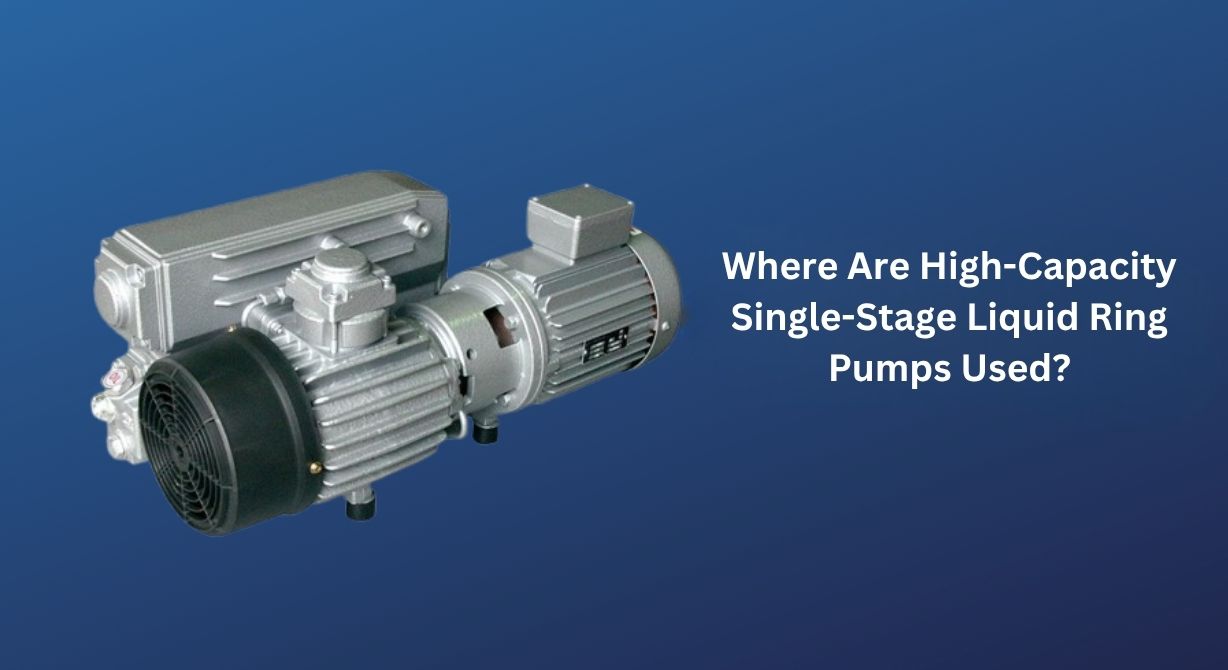
One Large Pump or Several Smaller Pumps for a Central Vacuum System?
In some facilities, the vacuum needs of multiple process points are met through a single central vacuum system. Two basic approaches exist for that setup: use one high-capacity pump, or connect several mid-capacity pumps in parallel.
A single large pump generally means fewer pieces of equipment, simpler piping, and lower total investment cost — but it carries the risk that the whole system is affected if it fails. Multiple smaller pumps provide redundancy but require more equipment and more complex controls. The right approach should be evaluated on a project-by-project basis, based on the facility's continuity requirements and budget.

What Engineering Requirements Come With Pumps at This Capacity?
According to Gücüm Pompa's catalog, the largest single-stage models have wide inlet/outlet connections such as DN 200 and DN 300, shaft power up to 250 kW, and noise levels around 85±3 dBA. Equipment at this scale requires some additional engineering considerations beyond standard piping design.
Those considerations include a robust foundation with vibration isolation, pipe sizing and support suited to high flow rates, electrical infrastructure matched to high motor power, and acoustic measures where noise levels demand them. These details should be planned jointly between the installer and Gücüm Pompa's technical team during the project stage.
What Should You Consider When Selecting the Right Capacity?
When selecting a high-capacity single-stage pump, the total gas volume in the process (m³/h), the target vacuum level (mbar), and any vapor load need to be correctly determined. Whether the system runs continuously or in batches, whether redundancy is needed, and whether the existing infrastructure (electrical, water, piping) can support this capacity should also be assessed.
Sharing this data completely with Gücüm Pompa's technical team ensures both the correct model selection and reliable long-term operation of the system.
Frequently Asked Questions
Can a High-Capacity Single-Stage Pump Be Used for a Process That Needs Deep Vacuum?
Generally no; this series is optimized for high volumetric flow, and vacuum level stays around 100 mbar on the largest models. If deeper vacuum is required, a two-stage design or a booster-supported system should be considered instead.
How Many Vacuum Pumps Does a Paper Machine Typically Use?
This varies depending on the machine's size, speed, and number of process points; the exact number and capacity require a project-specific engineering calculation.
Which Pump Series Suits a Power Plant Condenser Vacuum System?
In general engineering practice, high-capacity single-stage series are preferred for this kind of system, which requires high volumetric flow. The exact model selection depends on the condenser's size and gas load; evaluating this with Gücüm Pompa's technical team on a project-specific basis is recommended.
Should You Keep a Backup Pump When Setting Up a Central Vacuum System?
If process continuity is critical, keeping a backup pump or connecting multiple mid-capacity pumps in parallel is recommended. The exact decision depends on the facility's tolerance for downtime and its budget.
