


Rotary vane (oil-sealed) vacuum pumps step in for many applications where liquid ring pumps aren't the preferred choice, thanks to their water-free operation and compact design. Gücüm Pompa's GPM series rotary vane pumps can reach down to 0.5 mbar (1 mbar on smaller models) with gas ballast closed. This article covers what this vacuum depth means in practice and which application types typically need this level of vacuum.
Table Of Contents
- What Does a 0.5 mbar Vacuum Level Mean?
- How Do Rotary Vane Pumps Reach This Level?
- Why Does Vacuum Impregnation Require Deep Vacuum?
- Why Does Resin and Epoxy Degassing Depend on Deep Vacuum?
- How Is Deep Vacuum Used in Vacuum Packaging?
- What Role Does a Rotary Vane Pump Play in Lab and Roughing Applications?
- What Should You Consider When Selecting the Right Model?
- Frequently Asked Questions
What Does a 0.5 mbar Vacuum Level Mean?
As covered in our article "How Are Absolute Pressure, mbar and mmHg Values Read in a Vacuum Pump Catalog?", standard atmospheric pressure is roughly 1013 mbar. Reaching 0.5 mbar absolute pressure means removing more than 99% of the gas originally present in the environment. That's noticeably deeper than the 33–40 mbar range liquid ring pumps typically reach.
In practice, a vacuum this deep is favored in processes that need to effectively remove gas or vapor from even the smallest voids within a material — the application types we go through in the sections below.
How Do Rotary Vane Pumps Reach This Level?
As explained in our article "What Is Gas Ballast and How Does It Manage Water Vapor in a Rotary Vane Vacuum Pump?", a rotary vane pump can reach down to 0.5 mbar (1 mbar on smaller models) per the catalog when gas ballast is closed; opening gas ballast to protect against water vapor raises that figure to 1.5 mbar. So an application targeting 0.5 mbar needs a process with a low-moisture or vapor-free gas stream.
Having the oil tank mounted on the pump itself, running without water, and a compact build let this depth of vacuum be delivered with relatively small equipment and no water infrastructure — making rotary vane pumps a good fit for small-scale or laboratory-type applications where liquid ring systems aren't practical.
Why Does Vacuum Impregnation Require Deep Vacuum?
Vacuum impregnation is a process that removes air from porous materials — electric motor windings, cast parts, or wood — so a resin, varnish, or impregnating fluid can fill their place. If the air trapped in the material's pores isn't fully removed, the impregnating fluid can't fully penetrate those voids, leaving air pockets in the final product that can create weak points in electrical insulation or mechanical strength.
Effectively removing air from those pores requires going far below levels close to atmospheric pressure; general engineering practice for this type of process typically favors a vacuum reaching sub-millibar levels. In that context, a rotary vane pump reaching 0.5 mbar can offer a practical solution for moderate-scale impregnation lines.
Why Does Resin and Epoxy Degassing Depend on Deep Vacuum?
Mixing resin, epoxy, or casting compounds entrains air bubbles into the material. If those bubbles aren't removed before the material cures, they can cause visual defects, mechanical weakness, or partial discharge in electrical applications.
In a vacuum degassing process, the material is placed in a vacuum chamber and pressure is reduced; the drop in pressure lets trapped air bubbles expand, rise to the surface, and burst. The vacuum depth needed for this depends on the material's viscosity and bubble size, but sub-millibar levels are generally preferred — a rotary vane pump reaching 0.5 mbar offers suitable capacity for this type of degassing application.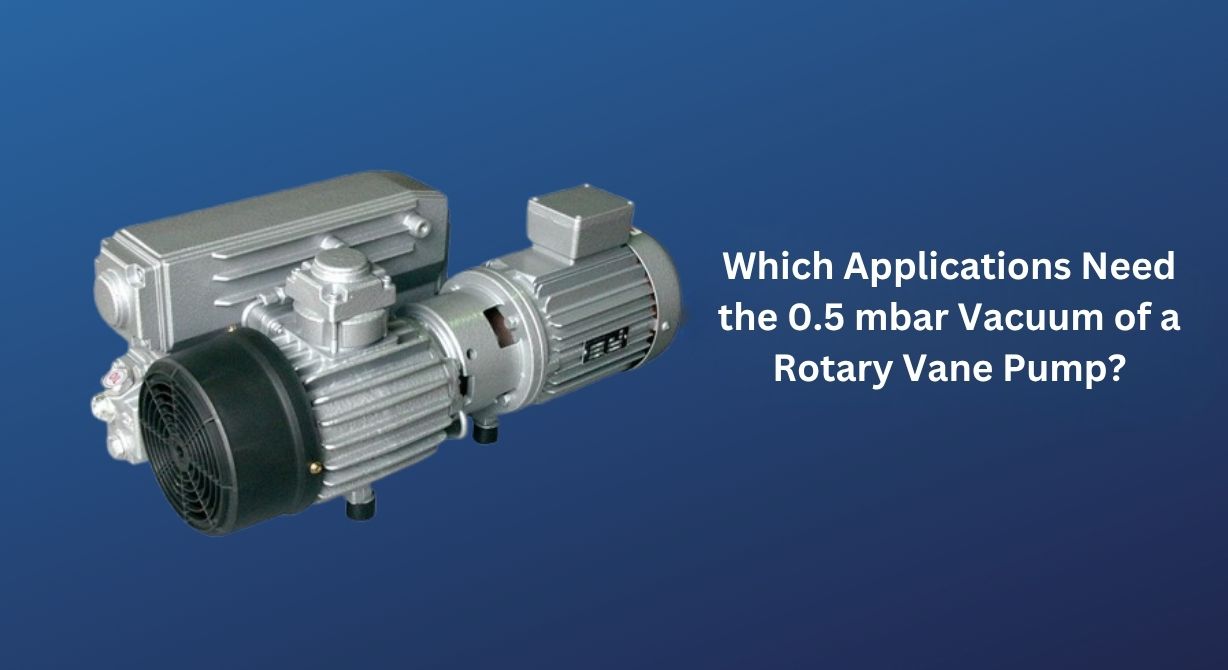
How Is Deep Vacuum Used in Vacuum Packaging?
In vacuum packaging of food and certain industrial products, removing as much air as possible from the package is important for extending shelf life and delaying oxidation. A deeper vacuum level further reduces the residual oxygen inside the package, strengthening this effect.
The water-free, compact, and relatively quiet build of rotary vane vacuum pumps makes them easy to integrate into vacuum packaging production lines — a practical advantage, especially in facilities running continuous production.

What Role Does a Rotary Vane Pump Play in Lab and Roughing Applications?
In laboratory settings, equipment such as rotary evaporators, vacuum ovens, or vacuum filtration setups needs moderate-to-deep vacuum for processes like solvent evaporation or sample drying. Rotary vane pumps are a technology commonly used in this kind of laboratory equipment.
In more advanced vacuum systems — coating equipment or analytical instruments requiring high vacuum, for example — a rotary vane pump often serves as the "roughing" stage: bringing the system down from atmospheric pressure to millibar levels, after which a secondary pump capable of reaching much deeper vacuum (a turbomolecular pump, for instance) takes over. This two-stage approach follows a similar staged logic to the one we covered in our article "What Is a Vacuum Booster and How Does It Reach the Vacuum a Liquid Ring Pump Cannot?"
What Should You Consider When Selecting the Right Model?
When selecting a model for a 0.5 mbar target, the moisture or vapor load in the process needs to be considered first; as covered in our articles "What Is Gas Ballast and How Does It Manage Water Vapor in a Rotary Vane Vacuum Pump?" and "How Is a Vacuum Pump Selected for Processes Involving Dense Vapor?", if gas ballast has to stay open for a vapor-laden gas stream, the achievable vacuum stays at 1.5 mbar and the 0.5 mbar target can't be reached.
The required pumping speed (m⊃3;/h) should also be selected from Gücüm Pompa's model range, spanning GPM 11 through GPM 308; lower-capacity models suit small laboratory applications, while higher-capacity models should be considered for industrial lines.
Frequently Asked Questions
Is 0.5 mbar a Very Deep Vacuum?
On an industrial scale, it can be considered a moderate-to-deep vacuum level; it's noticeably deeper than the 33–40 mbar range typical of liquid ring pumps, but far above the levels reached by high-vacuum or ultra-high-vacuum technologies, such as turbomolecular pumps.
Can You Reach 0.5 mbar With Gas Ballast Open?
No. According to Gücüm Pompa's catalog, the maximum vacuum reachable with gas ballast open is 1.5 mbar across all models. Targeting 0.5 mbar requires keeping gas ballast closed, which in turn requires the process to have a low-moisture gas stream.
What Capacity Should You Choose for Vacuum Impregnation?
Required capacity depends on the volume of the parts being impregnated and the size of the chamber. For an exact model selection, sharing process data — chamber volume, target evacuation time — with Gücüm Pompa's technical team is recommended.
Can a Rotary Vane Pump Always Replace a Liquid Ring Pump?
No. As covered in our article "Is a Liquid Ring or Rotary Vane Vacuum Pump More Suitable?", the right choice depends on factors like vapor tolerance, capacity needs, and water availability. Liquid ring pumps are generally more suitable for vapor-heavy or high-capacity processes.
