


A vacuum booster is auxiliary equipment used to increase the pumping speed and the achievable vacuum level of an existing vacuum pump. This article covers, in general terms, the operating principle of booster systems, their integration into an existing system, backing pump selection, and capacity calculation. To determine the right configuration for your application, you can consult the Gücüm Pompa technical team.
Table of Contents
- What Is a Vacuum Booster System and Why Is It Used?
- What Operating Principle Does a Vacuum Booster Rely On?
- How Is Adding a Booster to an Existing System Technically Implemented?
- How to Reach 1-5 mbar Vacuum Levels with a Booster?
- Why Is Backing Pump Selection Critical in a Booster System?
- Should a Single-Stage or Two-Stage Booster System Be Preferred?
- How Is Capacity Calculation Done in Vacuum Booster Systems?
- Which Technical Details Should Not Be Overlooked During Booster System Installation?
- How to Balance Energy and Cost in Vacuum Booster Usage?
- Frequently Asked Questions
What Is a Vacuum Booster System and Why Is It Used?
A vacuum booster system is a mechanical amplifier added in front of an existing vacuum pump that increases both the total pumping speed of the system and the vacuum depth it can achieve. The booster, which cannot operate on its own, is used together with a support pump called a backing pump. While the backing pump provides the required preliminary vacuum to the system, the booster deepens this vacuum and enables high flow capacity. In facilities that require high vacuum capacity but whose existing pump cannot meet this demand alone, a booster system can be an economical solution.
Vacuum booster systems are preferred especially in large volume processes to reach the 1 to 5 mbar vacuum range quickly and energy efficiently. Instead of purchasing a new high-capacity pump, reinforcing the existing system with a booster can reduce investment cost and installation time. Vacuum booster systems are among the solutions frequently used in the chemical, pharmaceutical, metallurgy, plastic processing, and food sectors.
What Operating Principle Does a Vacuum Booster Rely On?
The vacuum booster operates based on a rotary piston machine principle, also known as a Roots pump or Roots blower. Two figure-eight rotary rotors rotate synchronously, passing through each other without contact. During the rotation of the rotors, the captured gas volumes are transferred to the high-pressure side. There is no mechanical contact, sealing liquid, or lubrication requiring internal contact. This extremely low mechanical friction allows high pumping speed to be achieved with minimum energy expenditure.
The most distinctive feature of a Roots-type vacuum booster is that its characteristic curve, which expresses the change in pumping speed with pressure, remains quite flat over a wide pressure range. Its ability to keep the flow value stable during the transition from the medium vacuum range to deep vacuum makes the Roots-type booster the preferred solution in large volume processes. The compression ratio of a booster varies with the model and operating conditions; a booster can carry the vacuum provided by the backing pump several times deeper.
How Is Adding a Booster to an Existing System Technically Implemented?
Adding a booster to an existing vacuum system requires careful engineering evaluation. In the first step, it is checked whether the existing backing pump can meet the booster operating conditions. The backing pump must have the capacity to hold the exhaust pressure of the booster and have the mechanical durability suitable for continuous operation. The flow ratio between the booster and the backing pump is determined according to the manufacturer's recommendations; this ratio is critically important for the stable operation of the system.
In the physical integration process, the booster is connected in series between the vacuum system and the process equipment. Gas inlet is from the process side, and exhaust is directed to the backing pump. The inner diameter of the connection pipes should be selected to meet the nominal flow capacity of the booster; short and low-resistance line design is preferred. If the booster activation inlet pressure (bypass opening point) is not set correctly, the pump system may enter an oscillatory operating mode instead of stable operation; this both disrupts performance and accelerates mechanical wear.
How to Reach 1-5 mbar Vacuum Levels with a Booster?
A standard single-stage rotary vane oil pump, when operating alone, can usually reach an ultimate vacuum value in the range of 0.5 to 1 mbar. However, in large volume systems, the time to reach these pressure values is prolonged and the flow capacity may be insufficient. When a Roots-type booster is added in front of the same backing pump, the pumping speed of the system increases to several times the value provided by the backing pump alone in the medium vacuum range. The booster, which activates at an inlet pressure in the medium vacuum range, carries the system to the 1 to 5 mbar band much faster with its flow in this range.
For the 1-5 mbar range to be maintained stably, the booster activation inlet pressure and the bypass valve must be correctly calibrated. At the beginning, the system is brought down to a pressure where the booster can safely activate by the backing pump working alone; then the booster automatically activates and accelerates the transition to deep vacuum. The time to reach the target vacuum is shortened, energy efficiency increases, and process quality improves. This approach is widely used especially in vacuum drying, distillation, vacuum casting, and metallurgical heat treatment processes.
Why Is Backing Pump Selection Critical in a Booster System?
The performance of the entire booster system is limited by the technical characteristics of the backing pump. If the backing pump cannot continuously keep the exhaust pressure of the booster at a certain level, the booster cannot provide the desired vacuum depth and the system operates unstably. The backing pump flow must have the capacity to absorb the gas mass compressed and transferred by the booster. Insufficient backing pump capacity causes the booster's exhaust pressure to rise and the ultimate vacuum value to deteriorate.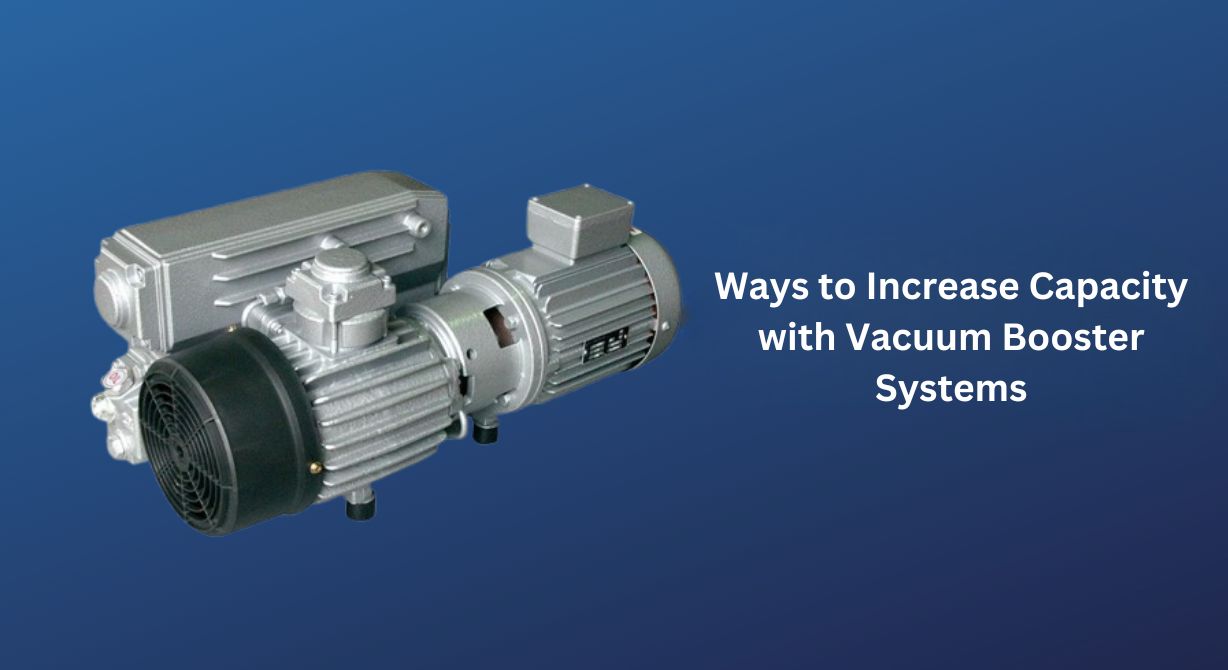
In backing pump selection, gas composition, moisture content, and chemical properties should also be taken into account. In processes containing corrosive gas, the material compatibility of both pumps should be evaluated together. Oil rotary vane pumps are the most common backing pump choice in general purpose booster system applications; however, in applications requiring clean gas, a dry type backing pump combination may be preferred.
Should a Single-Stage or Two-Stage Booster System Be Preferred?
A single-stage booster system combines a Roots booster with a backing pump. According to Gücüm Pompa product information, a system backed by a liquid ring pump can reach approximately 5–10 mbar absolute pressure, depending on operating conditions. Suitability must be assessed against gas and vapor load, service liquid temperature and pumping capacity, as well as the target pressure.
A two-stage booster configuration may be considered when a deeper vacuum is required. Gücüm Pompa lists 1–5 mbar for its two-stage systems. The number of stages alone does not guarantee a particular pressure: the backing pump, process load and operating conditions must be assessed together. Lower pressures quoted for general Roots booster applications must not be presented as a performance commitment for this product series.

How Is Capacity Calculation Done in Vacuum Booster Systems?
Capacity calculation for the booster system begins with determining the total pumping speed (in m3/h or l/s) required by the process. Process volume, leakage losses, gas generation rate, and the time to reach the target vacuum form the basic inputs of this calculation. The booster nominal capacity is selected by adding a suitable safety margin to the calculated pumping speed.
Then the backing pump capacity is determined. Taking into account the booster's compression ratio and nominal flow, the flow value of the backing pump at the minimum operating pressure is calculated. If the operating point cannot be verified on the backing pump characteristic curve, the system design should be reviewed. The Gücüm Pompa technical team provides technical support in project-based capacity calculations and booster system configuration selection.
Which Technical Details Should Not Be Overlooked During Booster System Installation?
Incorrect setting of the booster activation inlet pressure is one of the most common installation errors. If the booster activates before the backing pump brings the system to sufficient vacuum, gas backflow occurs and the pump system operates in an oscillatory manner. The activation inlet pressure must be kept above the minimum exhaust pressure at which the booster can operate; this value should be verified from the manufacturer's technical documents.
Thermal management is also a critical installation detail. Roots-type boosters produce heat during operation; excessive heating can cause rotor expansion and disruption of tolerances. The choice of air-cooled or water-cooled booster should be determined according to ambient temperature and continuous operating time. Vibration isolation, connection flexibility, and maintenance access areas are also elements that should be considered from the beginning in installation planning.
How to Balance Energy and Cost in Vacuum Booster Usage?
Vacuum booster systems can offer an energy advantage compared to large-capacity pumps operating alone because they can provide high pumping speed with relatively low power consumption. Since the mechanical friction of the Roots-type booster is extremely low, the increase in pumping speed it provides does not require a disproportionate increase in energy. With a booster added to the existing backing pump, the pumping speed can increase several times while the increase in total system power is generally smaller than that.
When establishing the cost balance, initial investment, installation, annual energy, and maintenance costs should be evaluated together. Adding a booster can provide savings in initial investment cost compared to purchasing a new large-capacity pump. The consultancy of the Gücüm Pompa technical team can make it easier to correctly calculate the total cost of ownership and determine a suitable solution in booster system integration.
Frequently Asked Questions
Can a Booster Be Added to Every Vacuum Pump?
Not every pump is directly suitable for booster application. The backing pump must have the capacity to hold the booster's exhaust pressure and be mechanically suitable for continuous operation. It is recommended to verify the compatibility of the existing pump with the booster with the manufacturer's technical support.
How Long Does It Take for a Booster System to Pay for Itself?
Adding a booster to an existing system can provide savings in initial investment cost compared to purchasing a new large-capacity pump. The payback period varies with system size, energy cost, and operating hours; it should be evaluated on a project basis, taking energy efficiency gains and increased production capacity into account.
Does a Booster System Require Maintenance?
In Roots-type boosters the rotors do not touch each other, so wear and lubrication requirements are low; the gearbox and bearings require periodic oil checks. In general, maintenance intervals are long. The maintenance schedule of the backing pump may require more frequent intervention compared to the booster.
How Many Stages of Booster Are Required for Vacuum Below 1 mbar?
A two-stage configuration may be considered when a single-stage system cannot meet the required pumping capacity and pressure. Gücüm Pompa product information lists approximately 5–10 mbar for a single-stage system and 1–5 mbar for a two-stage system, depending on operating conditions. Final selection requires a technical assessment of the process data.
In Which Sectors Are Vacuum Booster Systems Most Used?
Metallurgy and vacuum casting, pharmaceutical production and vacuum drying, chemical distillation and solvent recovery, plastic processing, semiconductor production, and vacuum furnace applications are among the sectors where vacuum booster systems are most commonly used. The common point is the need for high flow in the 1 to 10 mbar range in large volume systems.
