



A tiny air bubble spotted in a fired ceramic piece often traces back to an invisible pocket of trapped air left in the clay body during raw material preparation. In glass and ceramic manufacturing, vacuum steps in precisely to prevent that kind of defect, right at the stage before the raw material gets shaped. Gücüm Pompa serves the glass-ceramic and ceramic sectors with its ECO-SYS products as well.
Table Of Contents
- How Does Vacuum De-Airing Work in Ceramic Paste?
- What Role Does Vacuum Play in Slip Casting?
- Why Is Vacuum Preferred for Handling Glass Sheets?
- Where Is Vacuum Filtration Used in Raw Material Preparation?
- How Do You Select the Right Pump for These Applications?
- Frequently Asked Questions
How Does Vacuum De-Airing Work in Ceramic Paste?
In ceramic manufacturing, clay-based paste passes through a pug mill before extrusion or pressing. Mixing inevitably works air into the paste; that air expands during firing, leading to cracking, deformation, or a porous structure. Vacuum applied to a specific section of the mill draws that air out before the paste is shaped, resulting in a denser, more homogeneous mass.
This step is a critical quality control point, particularly for ceramic products requiring structural strength — roof tiles, bricks, sanitary ware components; a piece made from paste with air left in it turns out more brittle against sudden temperature changes during firing.
What Role Does Vacuum Play in Slip Casting?
Liquid-consistency ceramic slip is poured into plaster molds to take shape, but air bubbles that get mixed into the liquid during pouring can leave small pits or internal voids on the mold surface. On some casting lines, slip passes through a vacuum chamber before entering the mold, so those bubbles rise to the surface and burst first.
For complex geometries — ornamental sanitary ware, for example — this pre-treatment step contributes to a smoother cast that makes full contact with the mold surface.
Why Is Vacuum Preferred for Handling Glass Sheets?
Large glass sheets are fragile and flat-surfaced, which makes mechanical clamps a damage risk when handling them. Vacuum lifting equipment attaches to the sheet's surface through suction cups, applying lifting force spread across a wide area without putting pressure on any single point. This method is widely used on glass production lines to move sheets safely from the furnace exit to the cutting or packaging station.
The number of suction cups and total suction area is calculated based on the sheet's weight and the required safety margin — that calculation should be based on the largest and heaviest sheet the line handles.
Where Is Vacuum Filtration Used in Raw Material Preparation?
Clay and other ceramic raw materials arrive from the quarry carrying high moisture content. That moisture needs to be brought down to a specific level before pressing or extrusion; on some lines, this dewatering step is supported by vacuum pumps connected to separate vacuum filtration equipment. This application follows a similar logic to vacuum filtration in mining — except here the target isn't a mineral concentrate, but a raw material consistency ready for shaping.

How Do You Select the Right Pump for These Applications?
What these four applications share is that the gas stream coming from the process generally carries moisture, and capacity needs shift with line speed. Liquid ring vacuum pumps are the technology typically preferred for this kind of moist, variable-load application; depending on the line's scale, monoblock or two-stage series are worth considering.
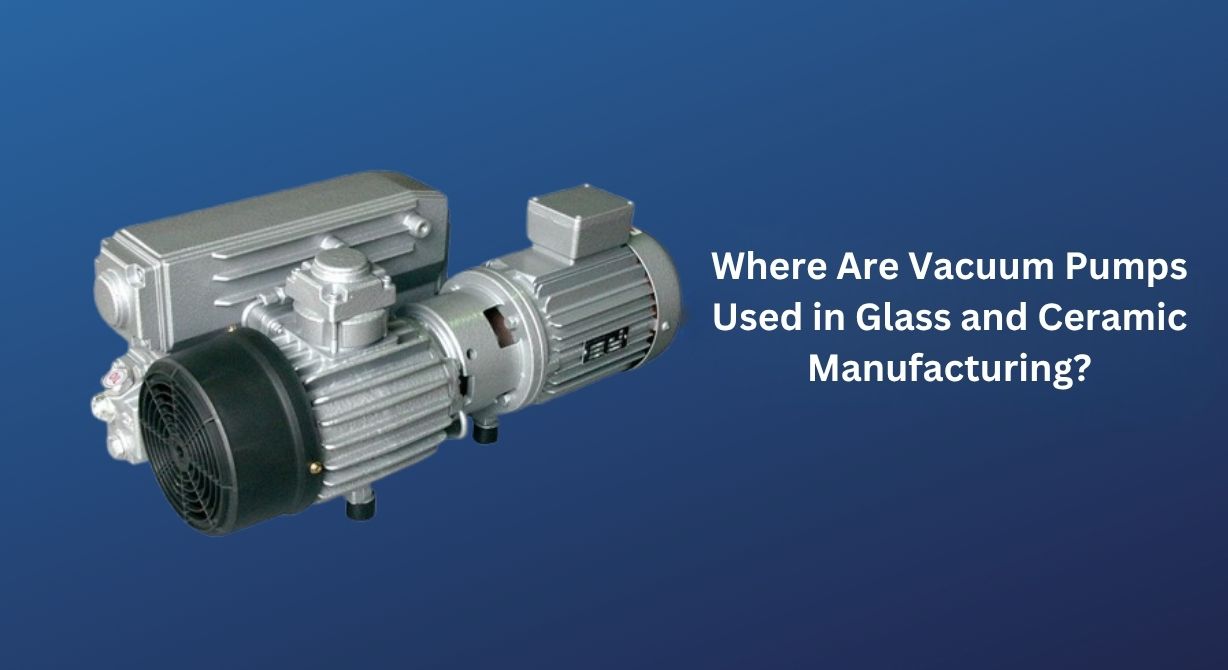
For drier, faster-response applications like glass sheet handling, rotary vane pumps can also be an option; the exact choice becomes clear once process conditions are shared with Gücüm Pompa's technical team.
Frequently Asked Questions
Can Ceramics Be Made Without Vacuum De-Airing?
Yes, but the risk of cracking or deformation during firing rises. That's why de-airing is a common standard step for products that need structural strength.
How Many Suction Cups Does Lifting a Glass Sheet Need?
That depends on the sheet's weight, dimensions, and the safety margin applied during lifting; the sheet's technical data needs to be shared with the equipment supplier for an exact calculation.
What Vacuum Level Is Sufficient for Slip Casting?
The exact value varies with slip consistency and mold geometry; determining it through process trials is recommended, and the process data can be reviewed with Gücüm Pompa's technical team.
Which Gücüm Pompa Series Is More Commonly Chosen for This Sector?
The right series should be determined together with Gücüm Pompa's technical team, based on the process's moisture load and target capacity.
